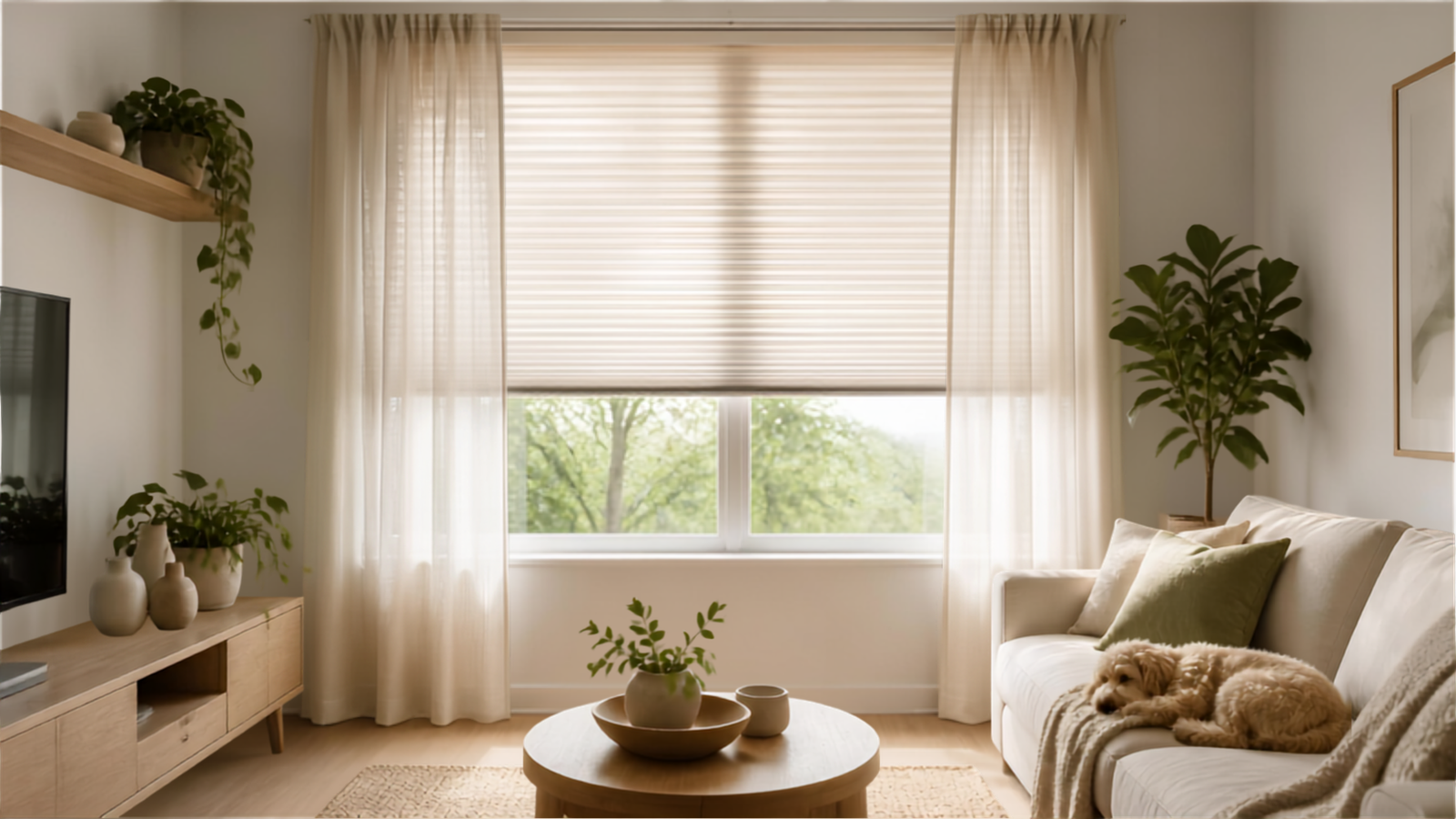
No-drill blinds and curtains can give you more privacy, better light control and a more comfortable home without permanently changing your walls or window frames.
That makes them particularly useful for renters, apartments, children’s rooms and anyone who simply doesn’t want to reach for a drill every time they want to improve a room.
But there is another reason we like this idea at OzKore.
Instead of complicated renovations, some surprisingly simple products can solve everyday problems: an adhesive pleated blind, a tension curtain rod, or even a removable window film.
Here are some of the smartest options we found.
1. The Simplest Option: Stick-On Pleated Blinds
Sometimes simple really is better.
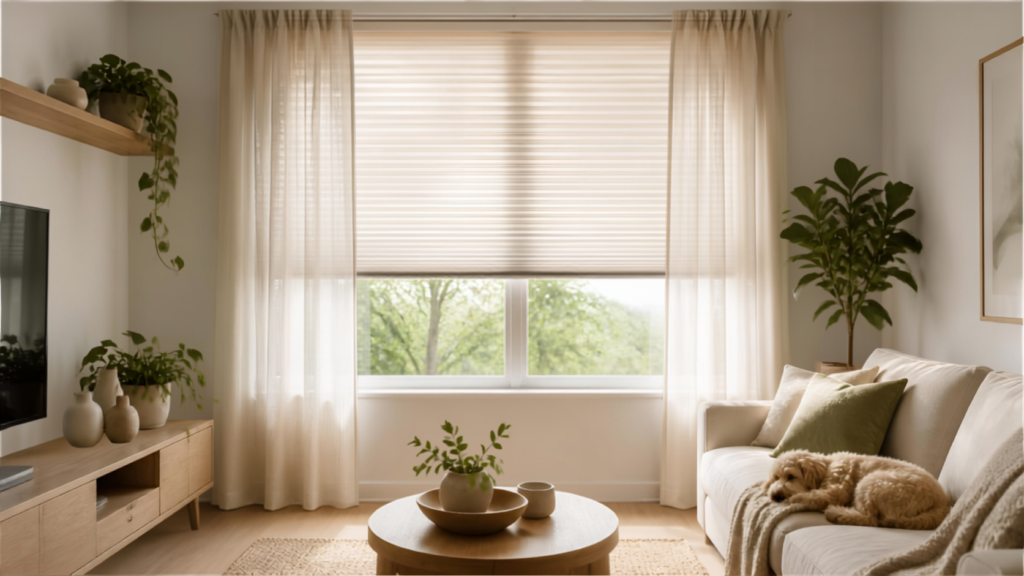
The IKEA SCHOTTIS Block-out Pleated Blind attaches directly to a smooth window frame without drilling.
It can also be cut to the size you need and secured at the bottom using the included hook-and-loop fastener.
For bedrooms, nurseries or temporary rental accommodation, that simplicity can be extremely useful.
There is also a material detail we particularly like: IKEA states that the main fabric is made from 100% recycled polyester.
The block-out version(HORNVALLMO Block-out version) is designed to completely darken the room rather than simply filter sunlight.
Why we like it
- no drilling
- cut-to-size design
- inexpensive way to test the concept
- block-out light control
- main fabric made from recycled polyester
- minimal hardware
It isn’t the most luxurious window treatment in the world.
But that’s not really the point.
For a renter who needs privacy or darkness without installing a permanent blind, it is a remarkably simple solution.
2. A Smarter Privacy Blind: Top Down, Bottom Up
This might be our favourite idea from the products we researched.
Traditional blinds usually work in one direction.
Open them and people outside may be able to see into your room.
Close them and you lose your daylight.
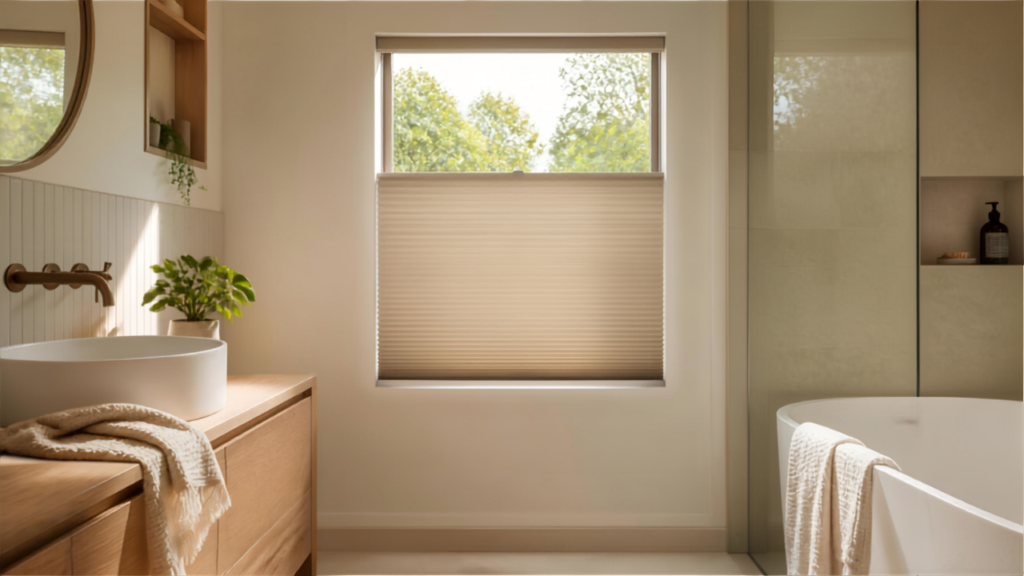
The IKEA HORNVALLMO Pleated Blind takes a different approach.
It can move from the top down or from the bottom up. You can even position it so that only the middle section of the window is covered.
Imagine a bathroom or street-facing bedroom.
Instead of covering the entire window, you could cover the section at eye level while allowing natural daylight through the top.
That’s a much smarter way to think about privacy.
The blind uses adhesive brackets rather than screws, and IKEA says the adhesive system has been tested for smooth glass surfaces.
The fabric in the light-filtering version is also listed as 100% recycled polyester.
Even better for family homes, the blind is cordless.
Best for
- bathrooms
- bedrooms facing neighbours
- street-facing apartments
- home offices
- children’s rooms
- renters who want adjustable privacy
There is also a block-out HORNVALLMO version if darkness is more important than filtered daylight.
3. The Classic Rental Hack: Tension Rod + Curtain
You don’t necessarily need a special blind.
One of the simplest renter-friendly combinations is:
tension rod + lightweight curtain
A tension rod stays in place by pushing against the two sides of a window recess.
No screws.
No drilling.
No electrician or installer.
Australian retailers currently sell adjustable tension rods in several sizes, and similar products are widely available through Amazon and other online marketplaces.
This approach gives you much more freedom because you can choose the curtain separately.
For daytime privacy, try a lightweight sheer curtain.
For bedrooms, choose a heavier block-out fabric if the rod is rated to support the weight.
OzKore Tip
Always check the rod’s recommended width and load capacity.
A tension rod extended too far or carrying a curtain that is too heavy is more likely to slip.
And if you have young children or pets, avoid creating a setup where a heavy rod could easily be pulled down.
Simple does not mean ignoring safety.
4. Don’t Want Curtains at All? Try Static Window Film
This was one of the most interesting alternatives we found.
Pillar UV-Defence Static Window Film attaches to glass without adhesive.
That means it can be removed and reused instead of permanently sticking something to the window.
According to Pillar, the film can block up to 98% of UV rays, while also helping reduce heat gain and providing privacy.
Because it is colourless, natural light can still enter the room.
That combination makes it particularly interesting for:
- bathrooms
- ensuite windows
- front-door glass
- windows receiving strong sunlight
- rental properties
- rooms where curtains take up too much visual space
You simply trim the film to suit the glass.
For small homes, this also has another advantage: there is no curtain hanging into the room and no blind mechanism occupying additional space.
5. Privacy Film Can Also Become Part of the Interior
Window film doesn’t have to look purely functional.
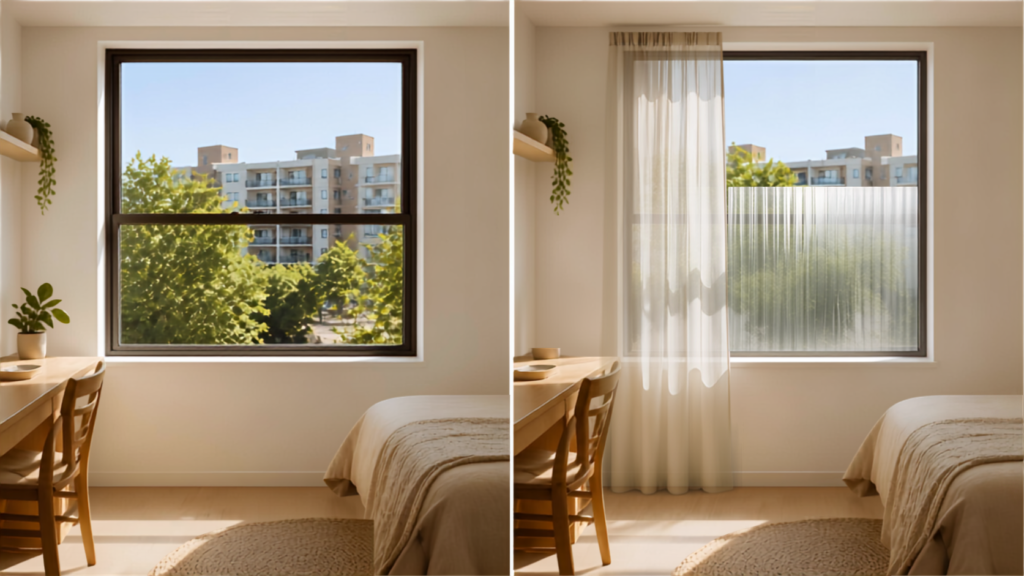
We also found static films designed to imitate textures such as fluted glass, frosted glass and decorative patterns.
This is a clever option for renters who love the look of architectural privacy glass but obviously cannot replace their landlord’s window.
A fluted-glass-style static film can create a similar visual effect while remaining removable.
We especially like this idea for:
- bathroom windows
- glass pantry doors
- laundry windows
- entrance sidelights
- home offices
- small apartments
Instead of adding another decorative object to a small room, the window itself becomes part of the design.
That’s very much the kind of small-space thinking we like.
6. Layer Two Simple Solutions Instead of Installing One Complicated System
Here’s another idea.
You don’t necessarily have to choose between privacy film and curtains.
Use both.
For example:
Static privacy film + tension rod + sheer curtain
During the day, the film provides privacy while allowing daylight into the room.
The curtain softens the room and adds texture.
For a bedroom you could instead try:
UV/privacy film + removable block-out blind
The film can help with daytime privacy and UV exposure, while the block-out blind handles sleeping hours.
Layering simple solutions can sometimes work better than installing one expensive permanent system.
How to Choose No-Drill Blinds and Curtains
Before buying no-drill blinds and curtains, check these six things.
1. Your Window Surface
Adhesive mounting systems usually require clean, smooth surfaces.
Textured walls and some window finishes may not hold adhesive products properly.
Static film is designed for glass, not walls.
2. Privacy vs Block-Out
These are not the same thing.
A light-filtering blind can provide privacy while still allowing daylight through.
A block-out blind is designed to significantly reduce or eliminate incoming light.
Choose based on the actual problem you are trying to solve.
3. UV Protection
Don’t assume every curtain or privacy blind blocks the same amount of UV.
If UV protection matters, look for a manufacturer that provides an actual UV specification.
For example, Pillar specifically states a UV-blocking figure for its UV-Defence film.
4. Child and Pet Safety
Cordless blinds are worth considering in homes with young children.
Also think about whether a pet could pull down a tension-mounted curtain or become tangled in loose cords or fabric.
The safest design is often the simplest one.
5. Materials
Look beyond the word “eco-friendly.”
Specific information is much more useful.
Recycled polyester content, reusable installation methods, replaceable components and durable materials give you something concrete to evaluate.
A product is not automatically sustainable simply because it doesn’t require drilling.
6. Removal
If you’re renting, think about removal before installation.
Will adhesive leave residue?
Can the film be peeled away?
Can the rod simply be taken down?
Always follow the manufacturer’s installation and removal instructions, and if you’re unsure about your lease conditions, check with your property manager before making changes.
Our Favourite Combination for a Rental Home
If we were setting up a rental apartment from scratch, we wouldn’t necessarily use the same solution on every window.
For a bedroom, we’d choose a removable block-out blind.
For a bathroom, a top-down/bottom-up blind or static privacy film makes more sense.
For a living room, a tension rod with a beautiful lightweight curtain can make the room feel softer without permanent installation.
And for windows receiving strong Australian sunlight, we’d look specifically for a removable film with verified UV protection rather than assuming any privacy film will do the same job.
The result can still look intentional and beautifully designed.
It just doesn’t need to be permanently attached to the building.
Eco-Conscious Doesn’t Mean Perfect
No-drill products still use materials such as polyester, plastics, aluminium and adhesives.
So we don’t think it is accurate to label every removable product “eco-friendly.”
A better approach is to ask:
Can I reuse it?
Does it contain recycled material?
Can I take it with me when I move?
Does it replace a renovation I don’t really need?
Will I keep using it for years?
For example, IKEA specifies recycled polyester in several of the pleated blinds discussed above, while Pillar’s static film is designed to be removable and reusable.
Those are specific features we can evaluate rather than relying on a vague green label.
Final Thoughts
The best no-drill blinds and curtains aren’t necessarily complicated.
Sometimes the smartest solution is a $10 tension rod, a removable blind or a sheet of static window film.
The important thing is choosing the right solution for the window.
Think about privacy, sunlight, UV exposure, children, pets and how easily the product can eventually be removed.
And if you’re furnishing a compact rental or apartment, windows are only part of the equation. Our guide to multifunctional furniture for small spaces explores more ways to make one piece of furniture perform several jobs without overcrowding your home.
A comfortable home doesn’t always require permanent renovations.
Sometimes it just requires a smarter idea.