Table of Contents
“Are you warm or cool?”
If you spend enough time watching Korean beauty videos, that question starts to sound almost as normal as asking someone their favorite lipstick.
Then come the seasons.
Spring warm. Summer cool. Autumn warm. Winter cool.
And suddenly choosing a pink lip tint feels considerably more complicated than it did five minutes ago.
Welcome to the world of Korean personal color analysis.
What started as a way of identifying flattering colors has grown into something much bigger in Korea. Personal color now appears across K-beauty, fashion, K-pop content, makeup shopping and even tourism.
For international visitors, it has also become one of the easiest ways to actually participate in Korean beauty culture rather than simply buying Korean products.
That is exactly why personal color fits so naturally into the new Korean “glowcation” trend.
What Is Korean Personal Color Analysis?
At its simplest, personal color analysis tries to identify colors that harmonize particularly well with your natural coloring.
Instead of asking only whether you like blue or pink, an analyst may look at factors such as undertone, brightness, saturation and contrast.
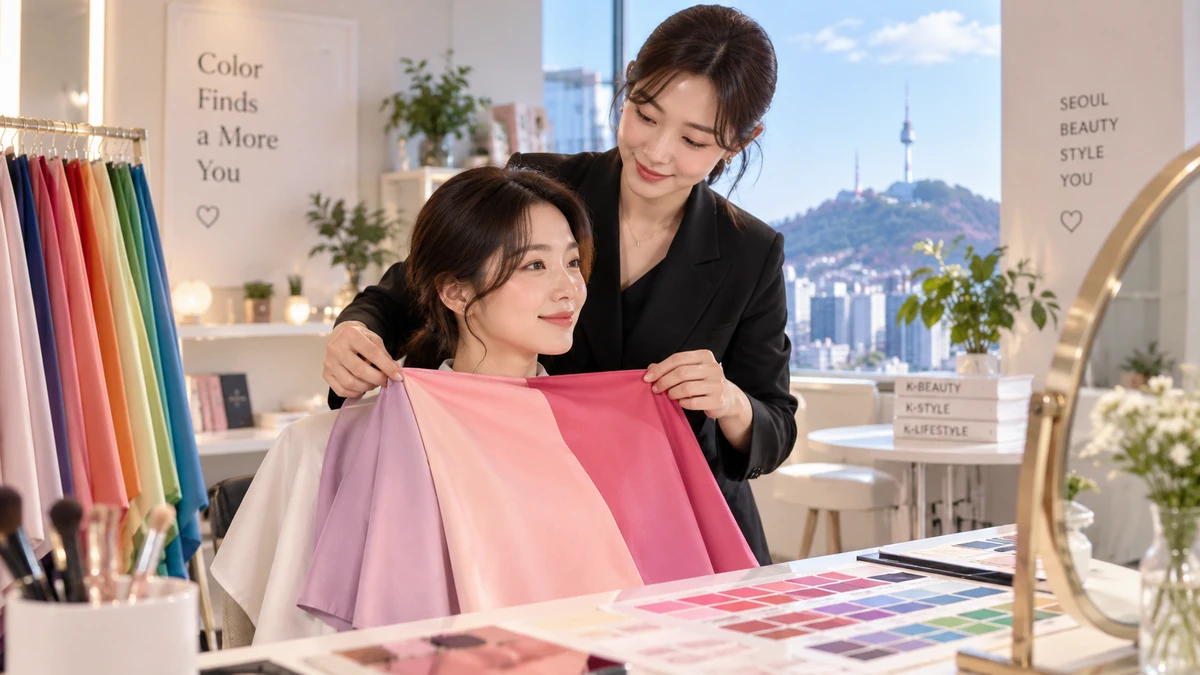
Different colored fabrics are commonly placed close to the face while you look into a mirror.
The difference can sometimes be subtle.
One shade may make shadows under the eyes appear stronger. Another may make the complexion look more even. A very bright color might overpower someone’s features, while a softer version of the same color feels much more balanced.
The goal is not to discover the only colors you are “allowed” to wear.
It is to build a useful reference for choosing makeup, clothes, hair colors and accessories.
What Do Spring, Summer, Autumn and Winter Mean?
The seasonal system is the part most people recognize from social media.
You will often hear results such as:
- Spring Warm
- Summer Cool
- Autumn Warm
- Winter Cool
But Korean consultations can go considerably deeper than four labels.
Analysts may also discuss whether lighter or darker colors work better, how much saturation suits you, whether muted shades are preferable and how much contrast your overall styling can handle.
That is why two people who are both classified as “winter” may leave with quite different recommendations.
The season is the beginning of the conversation, not necessarily the entire answer.
Why Did Personal Color Become So Big in Korea?
This is where the subject becomes more interesting than a color chart.
Modern Korean beauty culture places enormous attention on small adjustments.
A slightly different eyebrow shape, hair tone, lip color or blush placement can change the overall impression without creating an obviously dramatic transformation.
Personal color fits perfectly into that mindset.
Instead of saying “buy more makeup,” it asks a more specific question:
Which version of this makeup actually works for you?
That idea became particularly powerful as Korean cosmetics companies expanded their shade ranges and consumers gained access to endless lip, cheek and eye colors.
When there are 20 similar pink lip tints sitting in front of you, knowing whether you generally prefer warm, cool, bright or muted shades suddenly feels useful.
Then K-Pop Made Personal Color More Fun
Personal color also has something most traditional beauty consultations never had: fandom.
K-pop idols have been filmed getting their personal colors analysed, and fans naturally became curious about their own results.
The Korea Tourism Organization has even featured an international MONSTA X fan who travelled to Seoul for a personal color consultation after watching the group members receive their own analyses.
Her experience did not end when the fabrics came off.
The result affected the makeup colors and styling choices she considered afterward.
That is a perfect example of how Korean beauty and K-pop increasingly overlap.
A fan watches idol content.
The content introduces a Korean beauty experience.
The fan searches for it.
Eventually, that experience becomes something to try in Korea.
What Actually Happens During a Personal Color Consultation?
The exact process varies between studios, but a professional consultation often starts much more simply than people expect.
You sit in front of a mirror.
Makeup may need to be removed or kept minimal so the analyst can see your natural coloring more clearly.
Then comes the part everyone recognizes from videos: the drapes.
Different fabrics are placed below the face and changed one after another.
This comparison can help an analyst examine how your face responds to different:
- Warm and cool tones
- Light and dark colors
- Bright and muted colors
- High and low contrast
Depending on the service, the consultation may then move into makeup shades, clothing colors, jewelry metals, hair color or styling suggestions.
Some studios now go much further.
Korea Times reported in September 2026 that parts of Korea’s image-consulting industry have expanded beyond personal color into measurements of body proportions, facial structure and other styling factors.
In other words, the industry is moving from “Which colors suit me?” toward “How can my overall image be styled?”
Is Personal Color Analysis Scientific?
This is worth addressing because social media can make personal color sound like a biological fact.
It isn’t a medical diagnosis.
Color analysis is better understood as a styling system.
Lighting, makeup, hair color, personal preference and even the method used by an analyst can influence how colors are perceived.
You may also disagree with the result.
That is perfectly fine.
If your consultation says orange is not your ideal color and orange happens to make you ridiculously happy, wear orange.
The useful way to approach personal color is as a tool, not a rulebook.
Why Do Travelers Get Personal Color Analysis in Seoul?
You can now find color consultants outside Korea, so technically there is no need to fly to Seoul to discover whether muted blue suits you.
But that misses the point.
For K-beauty fans, doing it in Korea connects several experiences at once.
You receive the analysis and can then immediately walk into Korean cosmetics stores surrounded by products categorized by shades, finishes and undertones.
You might discover that half the lip products you normally choose are very different from the recommendations you just received.
That can make the next beauty-shopping trip considerably more interesting.
And perhaps considerably more dangerous for your wallet.
Personal Color Is Becoming Part of K-Beauty Tourism
Korea’s tourism industry is actively incorporating personal color into beauty experiences for international visitors.
The 2026 Korea Beauty Festival included one-on-one personal color consultations alongside K-pop-style makeup, hair and fashion experiences.
The festival also promoted hundreds of beauty experiences that international travelers could book during a Korea trip.
That matters because it shows how much K-beauty tourism has changed.
Beauty tourism used to sound like shopping or medical treatment.
Now there is a large middle ground filled with experiences: makeup, hair, personal color, styling, skincare and wellness.
Personal color is one of the clearest examples.
How Much Does Personal Color Analysis Cost in Seoul?
There is no single standard price.
Costs vary significantly depending on the studio, length of the session, whether the appointment is private or shared, interpretation, makeup services and how detailed the analysis becomes.
A quick experience can be very different from a multi-hour professional image consultation.
Some public K-beauty experience spaces have also offered simple personal color programs for free, while specialist studios charge for detailed one-on-one analysis.
Because services and prices change, check the current program directly before booking rather than relying on an old social media post.
Where Can You Try Personal Color Analysis in Seoul?
Personal color services can now be found across major Seoul neighborhoods including Myeongdong, Hongdae, Gangnam and Seongsu.
Rather than choosing a studio purely because an idol once visited it, compare what is actually included.
Look for:
- Whether the consultation is one-on-one or shared
- How long the session lasts
- Whether makeup recommendations are included
- Whether hair and clothing colors are discussed
- Whether English or another language is available
- Whether you receive a digital or printed color guide afterward
Those differences can matter more than the studio’s Instagram aesthetic.
Can You Try Personal Color Without Paying for a Full Consultation?
Yes.
Korea has experimented with lighter personal color experiences through beauty promotion spaces and events.
Some use cameras, kiosks or AI-based systems to suggest a color category, while others provide short consultations.
These should not necessarily be expected to give the same level of detail as a long professional session.
But if you are simply curious, they can be a fun introduction before deciding whether a full consultation is worth paying for.
What Should You Do With Your Result?
This is where personal color becomes useful rather than just entertaining.
Take the result shopping.
Instead of looking for a product because TikTok says everyone needs it, compare several shades within your recommended range.
Try the same idea with clothing.
Look at colors you already own and notice which ones you naturally reach for most often.
You may discover that your wardrobe already knew your personal color before you did.
And if the consultation recommends a shade you hate?
Ignore it.
Personal style should still feel personal.
How Personal Color Fits Into a Korean Glowcation
Personal color is almost the perfect first glowcation experience because it can influence everything that follows.
Do it near the beginning of a Seoul trip and the result can become a reference for makeup shopping, fashion browsing, hair appointments and other beauty experiences.
It is also non-medical, relatively easy to understand and gives you something you can continue using after returning home.
If you are new to the idea of a Korean glowcation, start with our guide to why Seoul is becoming a destination for K-beauty and wellness experiences.
From there, personal color is only one branch of a much larger beauty culture that now includes Korean scalp care, experiential beauty stores, Seongsu pop-ups, makeup styling and wellness.
FAQ
What is Korean personal color analysis?
Korean personal color analysis is a styling consultation that compares different colors against your natural coloring to identify shades that may work particularly well for makeup, clothing, hair and accessories.
What are the four Korean personal color seasons?
The broad categories are usually Spring Warm, Summer Cool, Autumn Warm and Winter Cool, although professional analysis can divide these into more detailed subcategories based on brightness, saturation and other characteristics.
Should I wear makeup to a personal color appointment?
Requirements vary by studio. Because makeup can affect how your coloring appears, some consultations may ask clients to arrive without makeup or remove certain products before the analysis. Check the studio’s instructions before visiting.
Can foreigners get personal color analysis in Seoul?
Yes. Personal color has become part of Korea’s international K-beauty tourism market, and some studios and beauty experiences provide foreign-language support. Language availability should still be confirmed before booking.
Is personal color analysis worth doing in Korea?
For someone interested in K-beauty, makeup or fashion, it can be a useful and entertaining experience. The value is greatest when you use the recommendations afterward rather than treating the result as a label you must follow.
Final Thoughts
Personal color may look like another beauty trend built for short-form video.
But its popularity in Korea makes sense.
K-beauty has always been unusually interested in detail: not simply red lipstick, but which red; not simply brown hair, but which temperature and depth of brown.
Personal color gives that attention to detail a system.
The best part is that you do not have to surrender your personality to it.
Find out whether you are spring, summer, autumn or winter. Take the useful recommendations. Try a lipstick you would never have picked before.
Then wear whatever makes you happy.
After all, finding your personal color should make personal style more fun — not less personal.
1 thought on “Korean Personal Color Analysis: Why Everyone Is Getting Their Colors Done in Seoul”