Table of Contents
There is a moment in Seongsu when you realize you are no longer simply shopping.
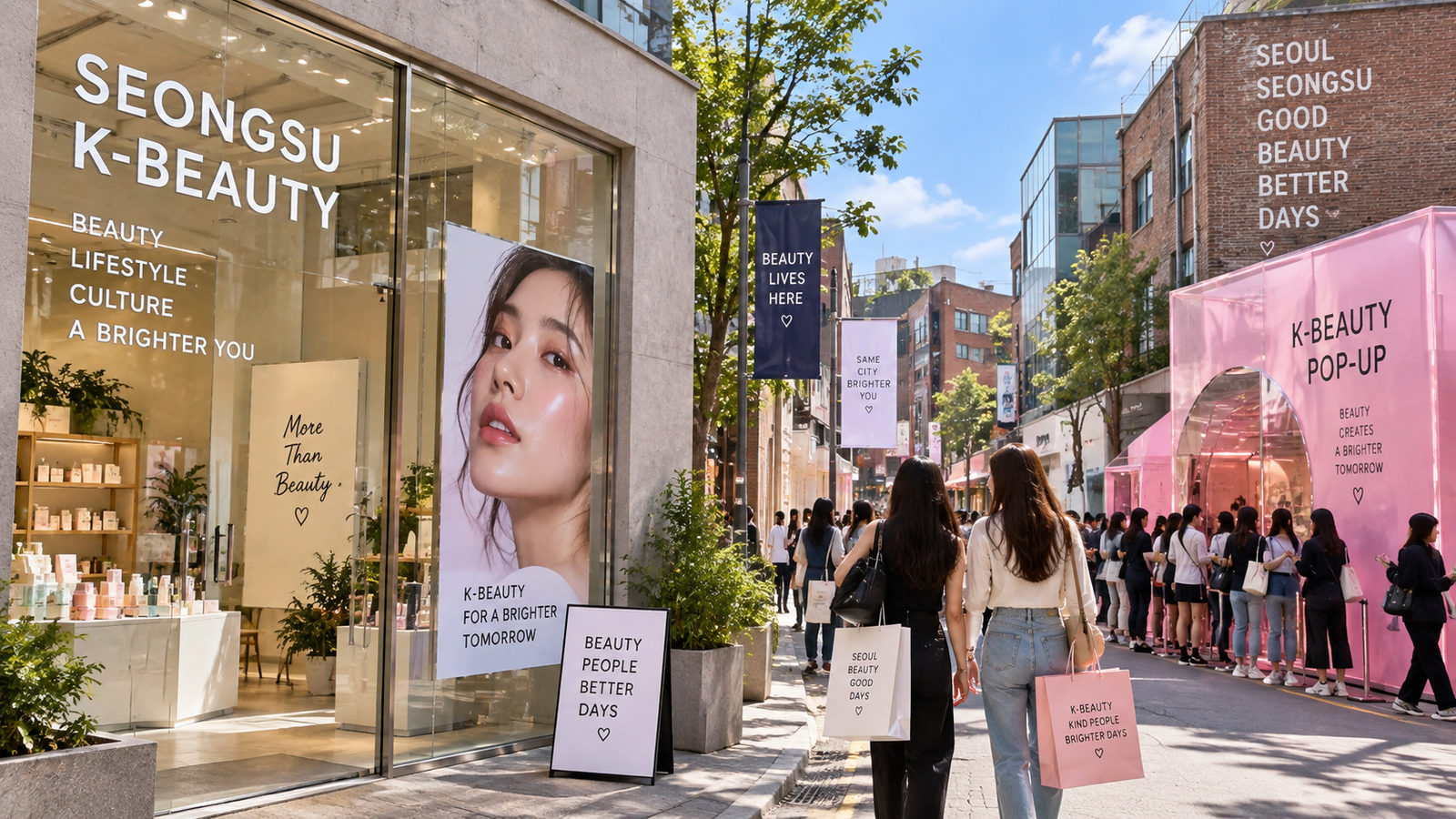
You walk past an old industrial building and discover a beauty flagship inside. Around the corner, people are lining up for a pop-up that may disappear in a few weeks. Across the street, another brand has created a space that looks more like an exhibition than a cosmetics store.
Then there is coffee. Fashion. Fragrance. Photo booths. More beauty.
Welcome to Seongsu K-Beauty.
Seongsu-dong has become one of Seoul’s most influential trend neighborhoods, and beauty is now a major part of the reason international visitors come here.
Myeongdong may still be easier if your goal is simply to fill a shopping bag.
Seongsu offers something different.
It lets you see where Korean beauty trends are being tested, photographed, experienced and turned into culture.
Why Is Everyone Going to Seongsu?
Seongsu did not begin as a beauty district.
The neighborhood was historically associated with factories, warehouses and shoe manufacturing. Over time, old industrial spaces began attracting cafés, studios, designers and creative businesses.
Instead of completely erasing that industrial past, many newer spaces used it.
Concrete walls, exposed structures and warehouse-style buildings became part of the neighborhood’s identity.
That combination gave brands something valuable: space to experiment.
Today, walking through Seongsu can feel like walking through a constantly changing showroom for contemporary Seoul.
Fashion brands test concepts here.
Beauty companies launch flagships here.
Pop-ups appear and disappear.
Young Koreans come to see what is new.
And international travelers increasingly follow.
Seongsu Is Becoming a Global K-Beauty Destination
This is no longer simply a neighborhood trend noticed by local shoppers.
In the first half of 2026, Seoul recorded about 8.2 million international visitors, while international card spending reached roughly KRW 5.6 trillion.
Seoul’s tourism data showed spending expanding beyond traditional visitor areas such as Myeongdong and Gangnam into neighborhoods including Hongdae and Seongsu.
Beauty spending by international visitors also rose strongly during the same period.
That helps explain what you now see on the streets.
Foreign visitors walk through Yeonmujang-gil carrying shopping bags, photographing storefronts and moving between cafés, fashion shops, fragrance stores and beauty flagships.
Seongsu is no longer somewhere tourists accidentally discover.
For many visitors, it is already on the itinerary.
Why K-Beauty Brands Love Seongsu
Traditional beauty retail is simple.
Put products on shelves. Add testers. Offer a promotion. Make the sale.
Seongsu encourages brands to do much more.
A store can become a laboratory, gallery, café, photo zone or temporary fantasy world.
That matters because modern K-beauty is increasingly about discovery.
Consumers do not necessarily arrive knowing exactly which serum they want.
They want to test textures, discover emerging brands, understand ingredients, take photos and experience the personality behind the product.
Seongsu gives brands room to turn that process into entertainment.
The Pop-Up Store Is Part of the Attraction
If you want to understand Seongsu, you need to understand Korean pop-up culture.
In many cities, a pop-up store is simply a temporary shop.
In Seongsu, it can become an event.
A beauty brand might transform an entire building around one product launch. Visitors may move through themed rooms, complete small games, collect samples, take photos and receive limited merchandise.
The product is only part of the experience.
The space itself is content.
That is why queues outside Seongsu pop-ups have become such a normal part of the neighborhood.
Seoul’s official tourism guide has described this sense of “real-time” experience as one of Seongsu’s attractions: visitors come because something interesting may be happening right now that will not exist in exactly the same form later.
Beauty Events Are Taking Over Entire Streets
The scale of beauty activity in Seongsu is also increasing.
In August 2026, Musinsa Beauty Festa turned parts of the neighborhood into what was effectively a K-beauty road.
Sixty-four beauty brands participated.
Instead of presenting every company in identical retail booths, brands created individual concepts and experiences.
That tells us something important about Seongsu.
The neighborhood is not simply attracting beauty stores.
It is becoming a stage on which Korean beauty brands compete for attention.
Start With Olive Young — But Do Not Stop There
For first-time K-beauty shoppers, Olive Young remains one of the easiest places to understand what is currently popular in Korea.
Seongsu takes that familiar experience and makes it bigger.
Olive Young N Seongsu is designed as more than a conventional neighborhood cosmetics store, with a stronger emphasis on discovery and beauty experiences.
That makes it a useful first stop if you arrive in Seongsu feeling overwhelmed.
You can look at categories, test products and get a sense of which Korean brands are receiving attention.
But do not spend your entire Seongsu visit inside one retailer.
The real advantage of this neighborhood is what happens when you walk outside again.
Look for Brand Flagships
Some of the most interesting Seongsu beauty spaces belong to individual brands.
This is where you can understand a brand in a way that is difficult from an online product page.
Stores associated with beauty, fragrance and lifestyle brands such as Tamburins, Nonfiction, Dasique and Medicube have helped make the area especially attractive to younger beauty shoppers and international visitors.
But specific stores change.
That is an important rule for exploring Seongsu.
Do not build your entire day around a list written two years ago.
Check what is operating shortly before you visit.
Seongsu moves quickly.
Seongsu Is Especially Good for Discovering Smaller Brands
Olive Young can show you what is selling.
Seongsu can show you what might become popular next.
That difference is valuable for anyone deeply interested in K-beauty.
Smaller and emerging Korean brands use pop-ups and concept spaces to introduce themselves to consumers without needing a traditional permanent store.
You may encounter a product or brand you have never seen in your home country.
Sometimes that discovery is more interesting than buying another product already viral on TikTok.
Do Not Visit Seongsu With a Rigid Shopping List
This may be the most useful advice in this guide.
Seongsu rewards curiosity more than efficiency.
If your shopping list says:
- cleanser
- toner
- sunscreen
- lip tint
you could buy everything much faster somewhere else.
Come to Seongsu when you have time to wander.
Walk into the strange-looking building.
Check the queue.
Look at the poster outside the pop-up.
Test a fragrance you have never heard of.
Take a coffee break.
Then discover another beauty store on the way back.
The wandering is part of the experience.
Myeongdong vs Seongsu for K-Beauty
This is one of the easiest ways to understand the difference between the two neighborhoods.
Choose Myeongdong if you want:
- Convenient beauty shopping
- Many familiar Korean brands close together
- Tourist-friendly shopping
- Easy comparison of products and prices
- To buy a lot in limited time
Choose Seongsu if you want:
- Beauty flagships
- Pop-up stores
- Emerging brands
- Experiential retail
- Fashion and fragrance alongside beauty
- Trend-focused cafés and creative spaces
- To experience contemporary Seoul culture
Neither is automatically better.
They solve different problems.
For a first Korea trip, visiting both can make the contrast surprisingly interesting.
What About Seongsu vs Hongdae?
Hongdae remains one of Seoul’s most energetic districts for youth culture, shopping, music and nightlife.
Seongsu feels different.
It is less about late-night entertainment and more about brands, design, cafés, fashion, beauty and daytime exploration.
If your ideal Seoul afternoon involves browsing a beauty flagship, discovering a pop-up, having coffee in a converted industrial space and then looking through fashion stores, Seongsu is likely to suit you.
If you want buskers, clubs, street energy and nightlife afterward, Hongdae may fit better.
Where Should You Start?
For most first-time visitors, Seongsu Station is the simplest starting point.
From there, explore the streets around Yeonmujang-gil rather than treating Seongsu as one specific attraction.
Many of the neighborhood’s most interesting discoveries are close enough to combine on foot.
Naver Map can be particularly useful because stores and pop-ups may not always appear exactly as expected on international map services.
Save several places before arriving, but leave space between them.
You will probably find something else.
A Simple Half-Day Seongsu K-Beauty Route
You do not need a minute-by-minute itinerary.
Try this structure instead.
1. Arrive around Seongsu Station
Start by checking what pop-ups are currently operating nearby.
2. Visit a major K-beauty store
Use a large retailer or flagship to get your bearings and see current beauty categories.
3. Explore Yeonmujang-gil
Walk slowly and look for temporary stores, beauty flagships, fashion spaces and interesting side streets.
4. Take a café break
Seongsu’s café culture is part of the neighborhood rather than an interruption to the shopping.
5. Visit one or two brand-specific spaces
Choose brands you genuinely find interesting rather than trying to visit every viral store.
6. Finish with beauty or fashion shopping
By this point, you will probably have discovered something that was not on your original list.
That is a successful Seongsu day.
How Much Time Do You Need in Seongsu?
Give yourself at least half a day if K-beauty, fashion or cafés are important to you.
You can technically walk through the main area much faster.
But speed defeats the purpose.
Queues, pop-ups, product testing and café stops can easily turn a two-hour plan into four or five hours.
If you find a major event happening, Seongsu can occupy most of a day without much effort.
When Is the Best Time to Visit?
Weekdays are generally easier if your priority is browsing rather than crowds.
Weekends can feel much busier, particularly around popular pop-ups and newly opened spaces.
However, temporary events may operate on specific dates, so the “quietest” day is not always the most interesting day.
Before visiting, check current brand social accounts and Korean map listings for opening hours and temporary events.
Do this close to your travel date.
In Seongsu, freshness matters.
Do You Need Reservations?
Normal retail shopping usually does not require a reservation.
But individual beauty experiences, workshops, consultations or high-demand pop-ups may use advance bookings, timed entry or same-day queues.
Never assume a viral experience works as a walk-in simply because someone on social media walked straight inside.
Check the current rules for the specific experience.
Do Not Chase Every Viral Pop-Up
There is a downside to Seongsu’s popularity.
FOMO.
You can easily spend an hour standing in line because a store appeared in a video with two million views.
Before joining a queue, ask yourself:
Do I actually want what is inside?
If the answer is no, keep walking.
There will probably be another interesting space five minutes away.
Your Seoul trip does not become less authentic because you skipped a viral photo booth.
How Seongsu Fits Into a Korean Glowcation
Seongsu may be the neighborhood that best explains the idea behind a Korean glowcation.
A glowcation is not simply a trip where you buy skincare.
It is travel shaped partly around Korean beauty and wellness experiences.
You might begin your trip with a Korean personal color analysis to understand which makeup and clothing shades suit you.
Another day could include a Korean scalp care or head-spa experience.
Then Seongsu becomes the discovery day.
This is where you see new products, retail concepts, beauty technology, fragrances, fashion and emerging brands all competing for attention.
Together, those experiences tell a much richer story about Korean beauty than one giant shopping haul ever could.
FAQ
Is Seongsu good for K-beauty shopping?
Yes. Seongsu has become a major destination for K-beauty flagships, pop-ups, multi-brand retail and emerging beauty brands. It is particularly useful for travelers interested in trends and experiential retail rather than shopping only from a fixed product list.
Is Seongsu better than Myeongdong for K-beauty?
It depends on your goal. Myeongdong is generally more convenient for concentrated tourist shopping, while Seongsu is stronger for pop-ups, flagship experiences, emerging brands and contemporary Seoul lifestyle culture.
Are Seongsu pop-up stores permanent?
No. Many pop-ups are temporary and can change quickly. Check current information shortly before visiting rather than relying on an old itinerary.
How long should I spend in Seongsu?
A half-day is a good starting point for travelers interested in beauty, fashion and cafés. Allow more time if you plan to queue for popular pop-ups or attend a specific experience.
What subway station should I use for Seongsu?
Seongsu Station on Seoul Subway Line 2 is a convenient starting point for exploring the main Seongsu shopping and pop-up area.
Is Seongsu only about K-beauty?
No. Part of its appeal is the combination of beauty, Korean fashion, fragrance, cafés, food, design and pop-up culture. That mix is what makes Seongsu different from a conventional cosmetics shopping district.
Final Thoughts
Myeongdong shows you what Korea is selling.
Seongsu often shows you what Korea is experimenting with.
That is why the neighborhood matters to K-beauty fans.
You may arrive looking for skincare and leave remembering a strange pop-up, a fragrance you had never heard of, an industrial café and a tiny beauty brand you discovered by accident.
Do not try to conquer Seongsu.
Give it a few hours, keep your itinerary loose and see what is happening when you arrive.
Because in a neighborhood built around what is new right now, the best thing you find may be the one that was never on your list.