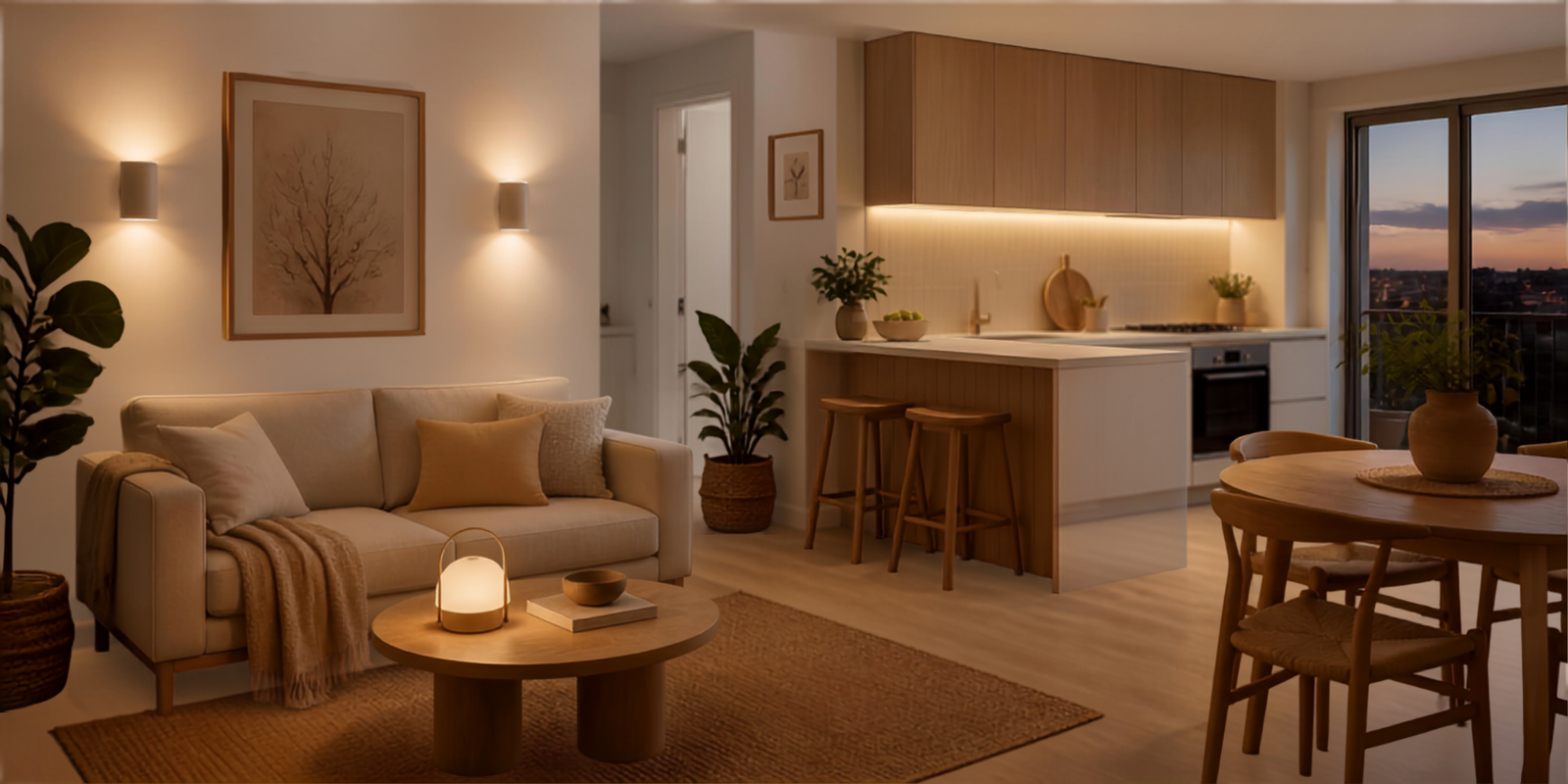
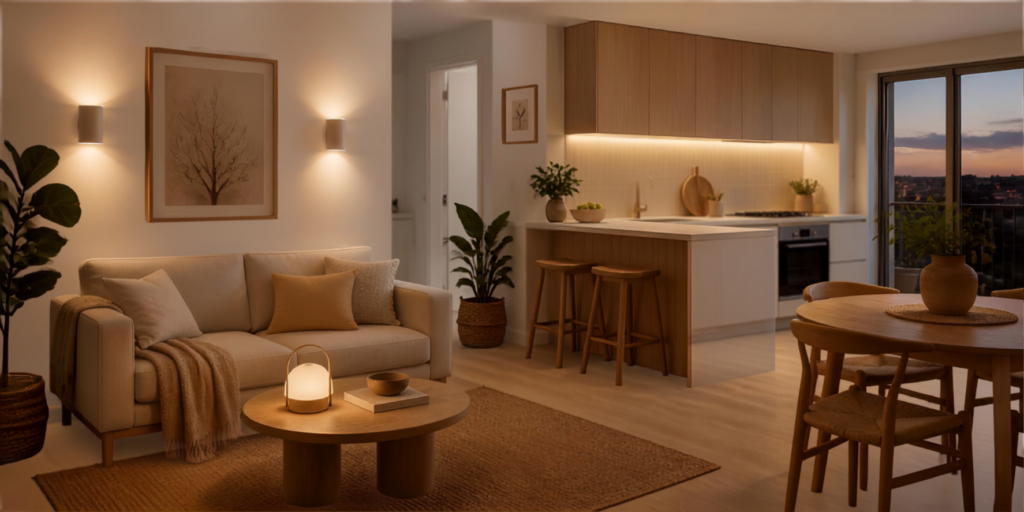
Cordless lights for home can brighten dark kitchens, hallways, wardrobes and bedrooms without adding power points, running cables or hiring an electrician.
And some of the newest designs don’t even look like temporary battery lights.
Rechargeable wall sconces can create the look of built-in lighting. Slim magnetic light bars can sit almost invisibly underneath kitchen cabinets. Motion sensors can illuminate a hallway or wardrobe automatically when you walk past.
For renters and small homes, these simple lighting ideas can solve surprisingly annoying everyday problems.
Here are seven of our favourite ways to use them.
1. Rechargeable Wall Sconces Without Hardwiring
Wall sconces can make a bedroom look beautifully finished, but traditional wall lights often require electrical wiring.
Rechargeable wall sconces offer a clever alternative.
The Kmart 2 Pack Rechargeable Wall Sconce, for example, can be installed using self-adhesive backing instead of screws, although screw installation is also available.
The lights attach magnetically to their bases, so you can remove them for charging.
They also provide three brightness levels and warm white light.
This creates some interesting possibilities.
Put one on each side of the bed and you can create the look of built-in bedside lighting without taking up space on small bedside tables.
They could also work in:
- reading corners
- hallways
- beside a sofa
- small home offices
- rental bedrooms
There is an important family-safety consideration, however.
The manufacturer specifically warns that the product contains small magnets, which can cause serious injury if swallowed. Homes with young children should therefore consider placement very carefully and follow the manufacturer’s safety instructions.
OzKore idea: Instead of thinking of rechargeable wall lights as emergency lighting, treat them as part of your interior design.
2. Create a Kitchen-Bar Feel With Under-Cabinet Lighting
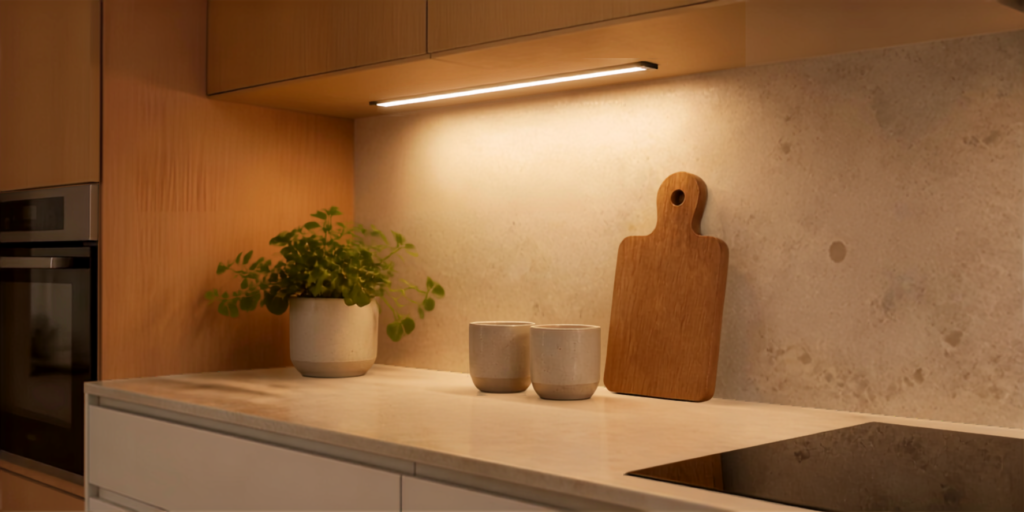
This is probably one of the easiest ways to make a basic kitchen feel more considered.
Place a slim rechargeable light underneath the overhead cabinets.
Suddenly the benchtop has its own layer of light.
The Click Rechargeable Magnetic Cabinet Light available through Bunnings is a good example of how much functionality can now fit into a small light bar.
The 400mm version offers:
- motion sensor activation
- 3000K warm light
- 4000K neutral light
- 6500K cool light
- dimming
- USB-C charging
- magnetic mounting
- rechargeable battery
The motion sensor has a stated detection range of 3–6 metres, while the 400mm model produces 170 lumens.
This is particularly useful in a kitchen because different colour temperatures can perform different jobs.
Use warmer light when you want a softer bar-like atmosphere in the evening.
Use brighter neutral or cooler light when preparing food.
And because the unit is rechargeable, you don’t need a conveniently positioned power point underneath the cabinet.
3. Let the Pantry or Wardrobe Light Itself
Opening a dark pantry and trying to read tiny labels isn’t much fun.
Neither is searching through a wardrobe while the main bedroom light is off.
This is where motion-sensor cordless lights for home become more practical than decorative.
The Arlec Rechargeable Motion Sensor Cabinet Light can operate in three ways: motion in darkness, motion in any lighting condition, or always on.
It also has three colour temperatures and adjustable brightness.
The light mounts magnetically onto an adhesive plate, so it can be removed when it needs charging.
That makes this type of light ideal for:
- wardrobes
- walk-in robes
- pantries
- linen cupboards
- under shelves
- storage cabinets
You don’t have to remember to turn it on.
Open the space, move nearby, and the sensor does the work.
That’s the kind of small convenience that doesn’t sound revolutionary — until you start using it every day.
4. Add Gentle Automatic Lighting for Night-Time Trips
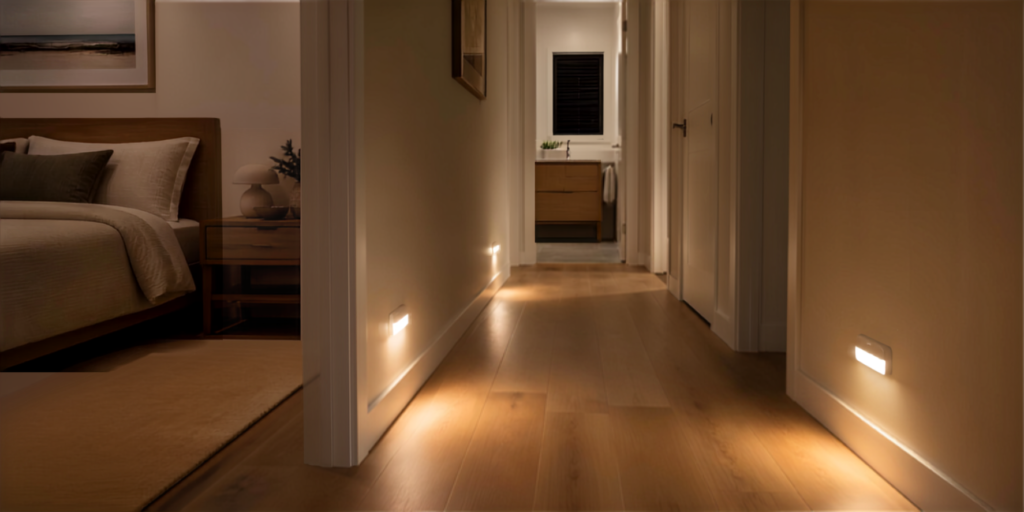
Bright ceiling lights aren’t always what you want at 2am.
A small motion-sensor light positioned low on a wall can provide enough illumination to help you move through the house without flooding the room with bright light.
This can be useful along:
bedroom → hallway → bathroom
or near stairs.
Rechargeable compact sensor lights are particularly useful because they don’t need to occupy a power socket.
Some users of EVOL rechargeable sensor lights report using them specifically on stairs, including when grandchildren stay over.
For family homes, we prefer positioning these lights low enough to illuminate the walking surface rather than directing bright light into someone’s eyes.
But motion-sensor lighting should be considered supplementary convenience lighting, not a substitute for required permanent safety or emergency lighting.
5. Turn an Awkward Corner Into a Reading Spot
Sometimes you have exactly the right place for a reading chair — and absolutely no power point nearby.
Portable rechargeable lamps solve that problem.
The IKEA NÖDMAST portable LED lamp can run without a cable and provides approximately 23 hours of full light when its recommended rechargeable batteries are fully charged.
Its shade can also be tilted slightly to direct the light.
More interestingly from our Eco-Conscious Check, IKEA specifies that parts of the lamp use polypropylene and polycarbonate plastic containing at least 50% recycled material.
That doesn’t make the entire lamp environmentally friendly.
But it is a specific material detail we can evaluate.
Instead of buying an extension cable or rearranging the whole room around a power point, you can simply move the lamp to where the light is actually needed.
6. Use One Portable Lamp in Several Rooms
Small homes don’t necessarily need a lamp permanently sitting in every corner.
A portable lamp can move with you.
The IKEA LAMPAN portable LED lamp, for example, is suitable for indoor and outdoor use and can operate for approximately eight hours at full brightness or more than 24 hours when dimmed to 30%, according to IKEA.
It can also change light colour and brightness.
Imagine using the same lamp:
on the dining table during dinner,
on the balcony later in the evening,
beside the sofa while reading,
and as soft ambient lighting when friends visit.
One movable object can potentially do the job of several fixed decorative lights.
That’s exactly the kind of multifunctional thinking we like for smaller homes.
7. Don’t Forget the Tiny Spaces
Not every lighting problem requires a beautiful lamp.
Sometimes you simply cannot see inside a cabinet.
The IKEA ROLFSTORP is an ultra-slim rechargeable light that can be positioned horizontally or vertically and fixed using self-adhesive tape.
It can run from rechargeable batteries or USB power and has three brightness levels.
This type of slim light can work particularly well:
- underneath a shelf
- inside a cabinet
- beside a small desk
- inside a craft cupboard
- near a coffee station
- in a small utility area
The best part is that the light itself almost disappears.
You notice the illuminated surface rather than the fitting.
How to Choose Cordless Lights for Home
Before buying rechargeable lighting, look beyond the styling.
1. Rechargeable vs Disposable Batteries
Where practical, we prefer rechargeable systems.
Repeatedly replacing disposable batteries creates unnecessary waste and ongoing cost.
USB-C charging is particularly convenient because many households already have compatible charging equipment.
2. Replaceable vs Built-In Battery
This is easy to overlook.
Some rechargeable lights contain batteries that cannot be replaced.
Others use removable rechargeable batteries.
A beautiful lamp isn’t necessarily a long-term purchase if the entire product becomes unusable when its battery eventually fails.
Check the specifications before buying.
3. Motion Sensor or Manual Control?
Motion sensors make sense in:
- wardrobes
- pantries
- stairs
- hallways
- utility cupboards
Manual dimming makes more sense for decorative bedside or living-room lighting.
Choose the feature based on the problem you’re solving.
4. Magnetic and Adhesive Mounting
Magnetic mounting is particularly convenient because the light can be removed for charging.
But adhesive mounting still requires care.
Check whether the manufacturer considers the adhesive suitable for your surface, follow the weight limits and installation instructions, and remember that adhesive can sometimes affect paint or finishes when removed.
“Rental-friendly” should never automatically mean “zero possibility of damage.”
5. Children and Pets
Avoid placing detachable lights with small magnets or components where young children can reach them.
Loose charging cables should also be stored away when they aren’t being used.
And don’t place rechargeable lights where pets can easily knock them down, chew components or reach batteries.
6. Choose the Right Brightness
A tiny night light and a kitchen task light have completely different jobs.
For an under-cabinet work surface, you may want stronger illumination.
For a hallway at night, softer light may be much more comfortable.
More lumens isn’t automatically better.
The Eco-Conscious Check
Cordless lighting isn’t automatically sustainable simply because it uses LEDs or doesn’t require electrical work.
Most products still contain plastics, metals, electronics and batteries.
So instead of applying an “eco-friendly” label to everything, ask better questions:
Is the light rechargeable?
Can the battery or LED be replaced?
Does the manufacturer disclose recycled materials?
Will one portable light replace several rarely used lamps?
Is the product useful enough that I will keep it for years?
There are some encouraging details among the products we researched.
IKEA specifies recycled-plastic content in parts of NÖDMAST, while its newer portable lamp designs also demonstrate that rechargeable lighting can include replaceable LED components.
But durability and repairability still matter.
The most sustainable light is not necessarily the one with the greenest marketing.
It may simply be the useful light you don’t need to replace.
Our Favourite Setup for a Small Home
If we were lighting a small apartment without changing the electrical system, we wouldn’t buy the same cordless light for every room.
We’d use a pair of rechargeable wall sconces beside the bed.
A slim motion-sensor bar would go underneath the kitchen cabinets.
Another small sensor light would go inside the pantry or wardrobe.
A low-level motion light could help illuminate the hallway at night.
And one attractive portable rechargeable lamp could move between the living room, dining table and balcony.
That’s five lighting problems solved without adding five new electrical points.
Final Thoughts
The best cordless lights for home solve a problem you already have.
Maybe there’s no power point beside the bed.
Maybe your kitchen bench is too dark.
Maybe you can’t see inside the pantry.
Or perhaps turning on the main hallway light at night is simply too bright.
Rechargeable and motion-sensor lighting can solve these little frustrations without turning them into renovation projects.
For renters especially, combining clever lighting with no-drill blinds and curtains can make a home feel much more finished without permanently altering the property.
And if you’re working with limited floor space as well, our guide to multifunctional furniture for small spaces explores how furniture can solve several problems at once.
A smarter home doesn’t necessarily need more technology.
Sometimes it just needs the right light in the right place.