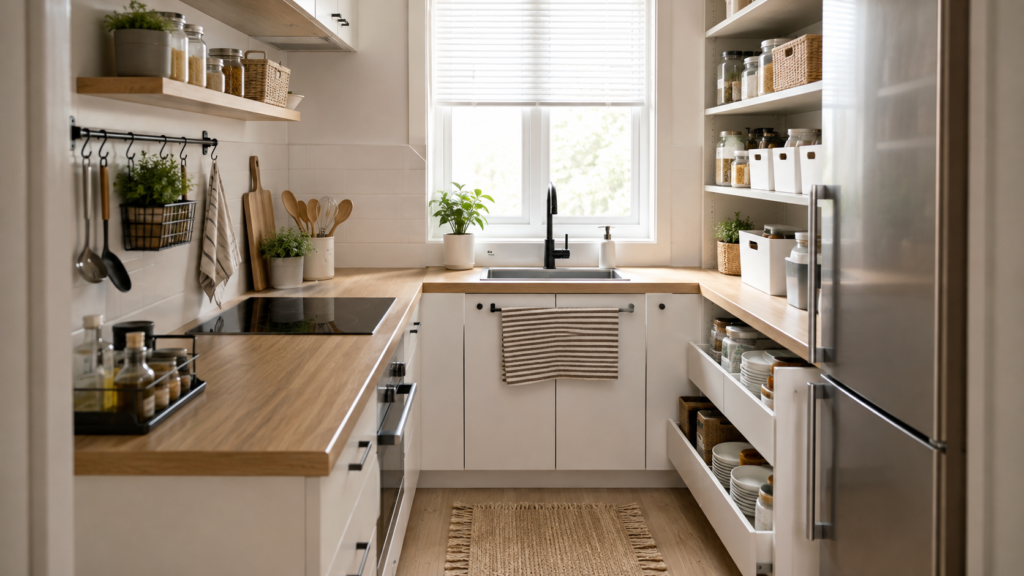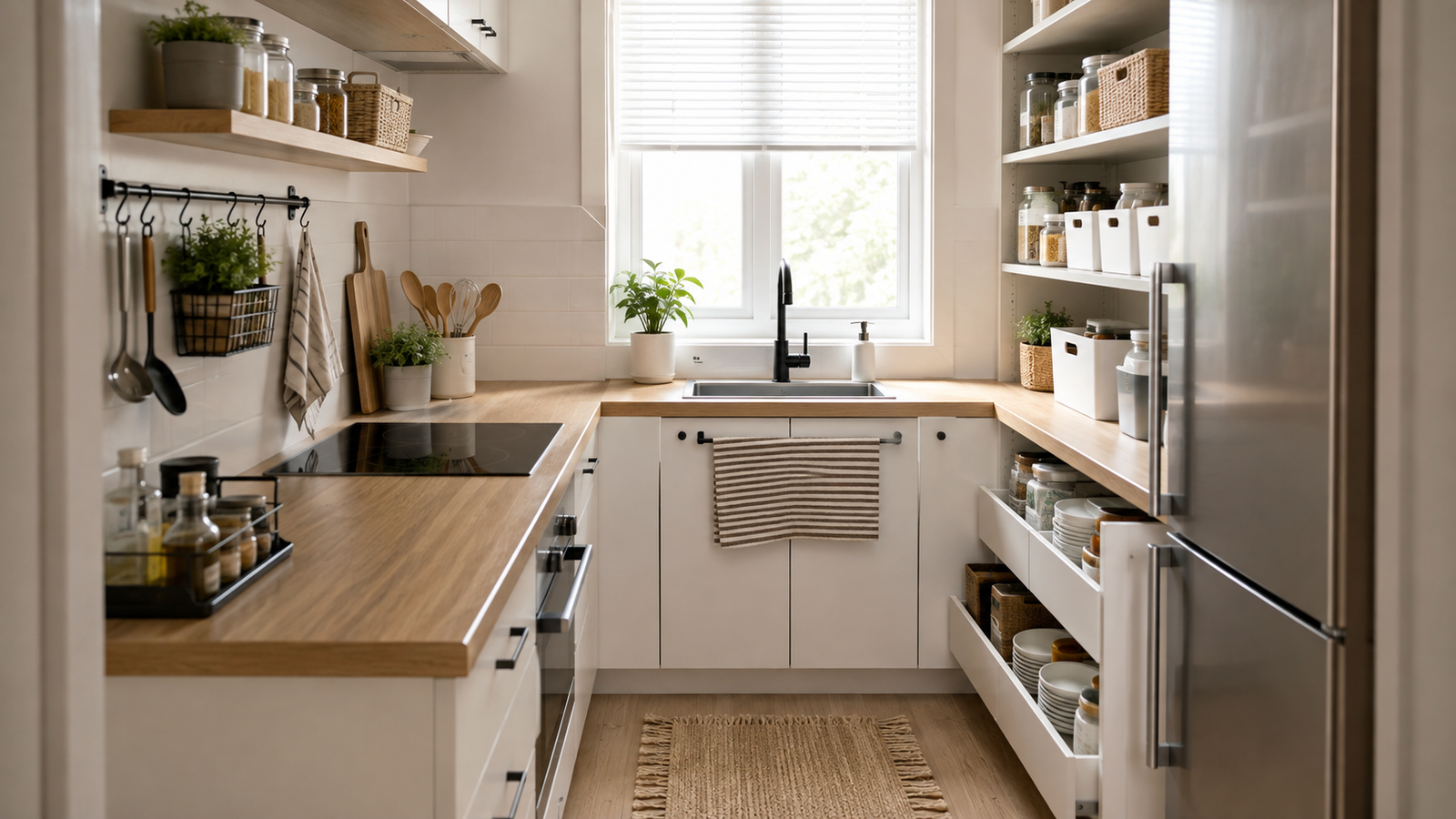
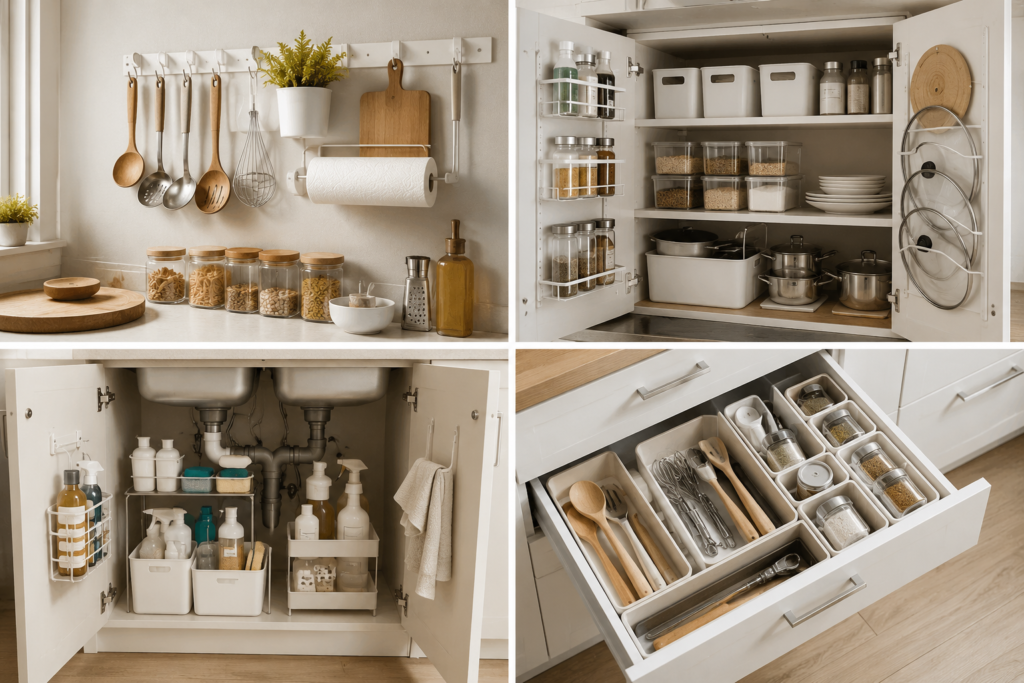
The best small kitchen organization ideas don’t add more storage furniture — they make the cupboards, drawers, walls and empty spaces you already have work harder.
A small kitchen can feel surprisingly spacious when everything has a logical home.
The problem is that many kitchens waste space in places we barely notice: above stacked plates, underneath shelves, inside cupboard doors, at the back of deep cabinets and underneath the sink.
Instead of filling every surface with baskets and containers, start by finding those unused spaces.
Here are nine practical ways to do it.
1. Turn Empty Space Under Shelves Into Storage
Look inside one of your kitchen cupboards.
There’s often a surprising amount of air between the shelf and the items underneath it.
An under-shelf organiser turns that unused vertical gap into an extra storage layer.
This works particularly well for:
- aluminium foil
- reusable food wraps
- baking paper
- sandwich bags
- tea towels
- lightweight packets.
A clever example is the CupboardStore Large Film, Foil & Bag Organiser from Joseph Joseph Australia.
It attaches underneath an existing shelf without tools and is designed for shelves over 33cm wide and up to 2cm thick. The manufacturer also states that it contains at least 50% post-consumer recycled plastic.
That’s exactly the kind of small-space product we like: it doesn’t require another cabinet and it uses space that was previously doing nothing.
OzKore idea: Before buying additional storage, look for empty air inside the storage you already have.
2. Create a Second Level Inside Deep Cupboards
Another common problem is stacking.
Bowls sit on plates. Mugs sit awkwardly on top of each other. Eventually you have to remove five things to reach one thing.
Shelf inserts can create a second level.
IKEA Australia specifically recommends shelf inserts and drawer organisers to improve storage efficiency inside existing cabinets.
Instead of one tall stack, you might have:
plates below → bowls above
or:
mugs below → glasses above
The cupboard hasn’t become larger.
You’ve simply started using its height.
This is one of the easiest small kitchen organization ideas because it can work without changing the kitchen itself.
3. Stop Stacking Pots and Pans Like a Tower
Pots are easy.
Pot lids are chaos.
If opening a cupboard causes three lids to slide onto the floor, consider storing cookware vertically rather than stacking everything horizontally.
An adjustable cookware organiser can separate:
pots | pans | frying pans | lids
so you can remove one item without dismantling the whole pile.
Joseph Joseph Australia offers an expanding cookware organiser designed specifically to separate pans, pots and lids in one adjustable unit.
But you don’t necessarily need a branded organiser.
The important idea is vertical separation.
A sturdy rack or divider you already own may do the same job.
That’s better than buying another organiser simply because it looks attractive online.
4. Use the Inside of Cupboard Doors
Cupboard doors are another overlooked storage surface.
They’re particularly useful for thin, lightweight objects.
Think:
- pot lids
- chopping boards
- measuring spoons
- cleaning cloths
- lightweight kitchen accessories.
Inside-door storage can make sense in a small kitchen because it creates storage without occupying the main shelf.
Joseph Joseph, for example, makes cupboard-door pan-lid holders as well as a chopping-board system that stores inside a cupboard door.
But measure first.
A door organiser that looks perfect online can prevent the cupboard from closing if it collides with the shelves inside.
Before buying: close the cupboard slowly while holding the intended item against the door. You’ll quickly see how much clearance you actually have.
5. Make Deep Drawers Easier to Use
A big drawer isn’t necessarily good storage.
Without organisation, it simply becomes a bigger place to lose things.
Divide drawers according to how you use the kitchen, not simply by product category.
For example:
Cooking drawer: spatula, tongs, thermometer, wooden spoon.
Baking drawer: measuring cups, whisk, scraper, baking tools.
Lunch-prep drawer: reusable bags, lunchbox accessories and wraps.
IKEA Australia recommends dividers, cutlery trays and even internal drawers as ways of increasing usable drawer storage.
Bamboo can also be worth considering for some organisers when you want to reduce the amount of new plastic in the kitchen, although material alone doesn’t automatically make a product sustainable.
Durability matters more.
An organiser you use for ten years is usually a better purchase than a fashionable one you replace next year.
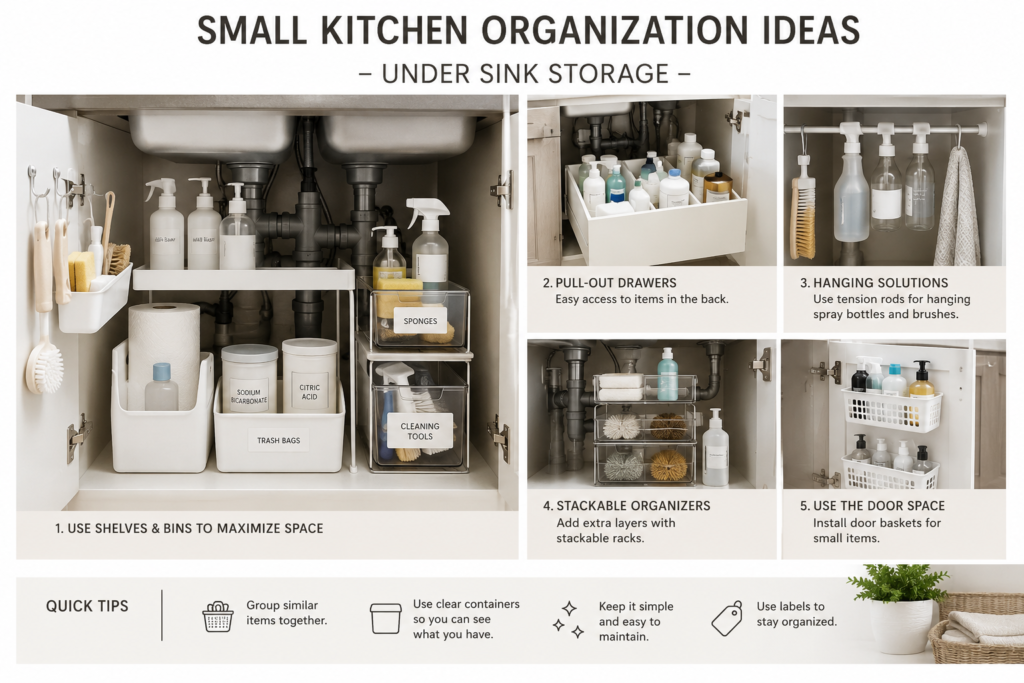
6. Give the Under-Sink Cabinet a Proper System
The cupboard underneath the sink is one of the hardest spaces in a small kitchen.
Pipes divide the cabinet.
Cleaning bottles are tall.
Small items disappear behind larger ones.
And because leaks can happen, expensive or moisture-sensitive storage isn’t always ideal.
Instead of one large container, create simple zones:
Daily cleaning
Dishwashing
Refills
Waste/recycling supplies
Use removable washable containers so a leak or spill can be cleaned easily.
If you have children or pets, this area needs extra consideration.
Cleaning products, dishwasher capsules and chemicals should be stored according to their safety instructions and kept securely away from children and animals. Don’t move hazardous products into attractive unlabelled containers just to make the cupboard look organised.
A Pinterest-perfect cabinet isn’t worth compromising safety.
7. Use Transparent Containers — But Don’t Decant Everything
Matching pantry jars look beautiful.
But transferring every grocery item into another container can create unnecessary work — and unnecessary products.
Use transparent storage selectively.
It’s particularly useful for foods you buy repeatedly in larger quantities, such as:
- rice
- oats
- pasta
- flour
- cereal
- nuts.
Seeing what you already have can also help reduce duplicate buying.
IKEA notes that transparent containers and visible “eat-me-first” areas can make food easier to see and help households reduce food waste.
But keep important information.
If you decant food, preserve expiry dates, allergen information and cooking instructions where relevant.
And don’t replace perfectly usable containers just because a matching set looks better on Instagram.
Use what you already own first.
8. Protect Your Benchtop From Storage Creep
Small kitchens often lose their most valuable space slowly.
A coffee machine arrives.
Then a toaster.
Then cooking utensils.
Then oils.
Then a fruit bowl.
Eventually there’s nowhere left to prepare food.
Treat the benchtop as workspace first and storage second.
Keep only things you genuinely use frequently.
A compact multifunctional organiser can help consolidate several objects into one footprint. For example, Joseph Joseph Australia makes a CounterStore organiser combining utensil and knife storage with a chopping board stored behind the unit.
You don’t need that specific product.
The design principle is more important:
Can one object replace two or three separate objects on the counter?
That’s the same thinking that works so well with multifunctional furniture in small homes.
9. Use Vertical Space Before Adding Another Cabinet
When floor space is limited, look upward.
A narrow freestanding shelf can sometimes fit beside a refrigerator or at the end of cabinetry.
Open shelving can also hold frequently used objects while keeping them visible.
But don’t cover every available wall.
Too much open storage can make a small kitchen feel visually smaller because the eye sees hundreds of individual objects.
Instead, choose one vertical storage zone and keep the rest relatively calm.
IKEA Australia shows the same principle at a larger scale, using tall storage and shelving to maximise available space while keeping frequently used items organised.
Renters: think removable first
If you rent, prioritise:
- freestanding shelves
- shelf inserts
- tension systems
- over-door storage
- removable organisers
- products specifically approved for tool-free installation.
Adhesive doesn’t automatically mean damage-free.
Always check the manufacturer’s instructions and test surfaces where appropriate.
What We Wouldn’t Buy for a Small Kitchen
More storage products aren’t always the answer.
We’d think twice before buying:
Huge matching container sets when you only need four containers.
Single-purpose organisers for items you rarely use.
Oversized countertop organisers that consume more preparation space than they save.
Cheap adhesive products carrying heavy objects above food-preparation areas.
Complex storage systems that require removing several pieces just to reach one everyday item.
The best storage makes something easier to access.
If an organiser makes the kitchen harder to use, it isn’t organising anything.
The Eco-Conscious Check
This section is now part of how we evaluate products at OzKore.
A storage product isn’t environmentally responsible simply because it’s bamboo-coloured, beige or marketed as “natural.”
Ask:
Can I use something I already own?
That’s always our first question.
Does it make better use of existing cabinetry?
An under-shelf organiser may eliminate the need for a separate piece of furniture.
Is recycled material actually specified?
For example, Joseph Joseph states that its CupboardStore Large Film, Foil & Bag Organiser contains a minimum of 50% post-consumer recycled plastic.
That’s a measurable claim rather than vague green marketing.
Will it last?
Durability matters.
Can it move with me?
Removable shelf inserts, freestanding racks and drawer organisers can move to another home, which is especially useful for renters.
Could organisation reduce food waste?
Seeing what you own makes it easier to use food before buying duplicates or letting ingredients expire. IKEA also connects visible storage and “eat-me-first” organisation with reducing food waste.
Eco-conscious organisation doesn’t mean buying an entire collection of “eco” storage.
Often it means buying less organisation equipment altogether.
Child & Pet-Friendly Kitchen Organisation
A beautifully organised kitchen still has to function safely.
Homes with children or pets should pay particular attention to where they store:
- cleaning chemicals
- dishwasher capsules
- sharp knives
- medications or supplements
- glass containers
- heavy cookware.
Store potentially hazardous items securely and follow the manufacturer’s safety instructions.
Heavy objects are generally better stored lower down rather than on lightweight adhesive shelving.
And be careful with small detachable components, magnets and clips that could become accessible to children or pets.
Safety comes before aesthetics.
Our Small-Kitchen Setup
If we were organising a small kitchen from scratch, we wouldn’t buy everything at once.
We’d start with five changes:
1. Clear the benchtop.
Anything rarely used moves away.
2. Add one extra level inside tall cupboards.
Use shelf inserts where there’s wasted vertical space.
3. Store pans and lids vertically.
Stop rebuilding the cookware tower every night.
4. Divide the under-sink cabinet into removable zones.
Keep household chemicals securely stored.
5. Organise the pantry according to visibility.
Put frequently used and soon-to-expire food where you can actually see it.
Then live with the kitchen for a week.
Only after that would we decide whether another organiser is actually necessary.
That’s the difference between organising a kitchen and shopping for organisation products.
Final Thoughts
The most effective small kitchen organization ideas aren’t about squeezing more possessions into a tiny room.
They’re about making the things you already own easier to see, reach and use.
Start with the wasted spaces: underneath shelves, inside doors, above stacked dishes, inside deep drawers and underneath the sink.
Then ask whether one simple solution can solve the problem without permanent installation or another bulky piece of furniture.
If your kitchen also feels dark, our guide to cordless lights for home shows how rechargeable under-cabinet lighting can brighten a worktop without adding a new electrical point.
And if limited space is a problem throughout your home, our guide to multifunctional furniture for small spaces looks at furniture designed to perform more than one job.
A small kitchen doesn’t need to hold more.
It needs to work better with less.
FAQ
How do I organise a small kitchen with very little storage?
Start by using wasted vertical space inside existing cupboards. Shelf inserts, drawer dividers, under-shelf storage and inside-door organisers can create usable storage without adding another cabinet.
How can I organise a small kitchen without drilling?
Look for freestanding shelves, shelf inserts, over-door organisers, tension systems and manufacturer-approved removable storage. Always check whether adhesive products are suitable for the surface before installation.
How do I keep small kitchen counters clutter-free?
Keep only frequently used appliances and tools on the counter. Store occasional items elsewhere and consider multifunctional organisers that consolidate several everyday objects into one footprint.
Are clear pantry containers worth it?
They can be useful for foods you buy regularly because they make quantities easier to see. However, you don’t need to decant everything. Reusing containers you already own can be cheaper and reduce unnecessary purchases.
What is the best way to organise pots and pans in a small kitchen?
Vertical dividers or adjustable cookware racks can make individual pans and lids easier to access than large horizontal stacks.