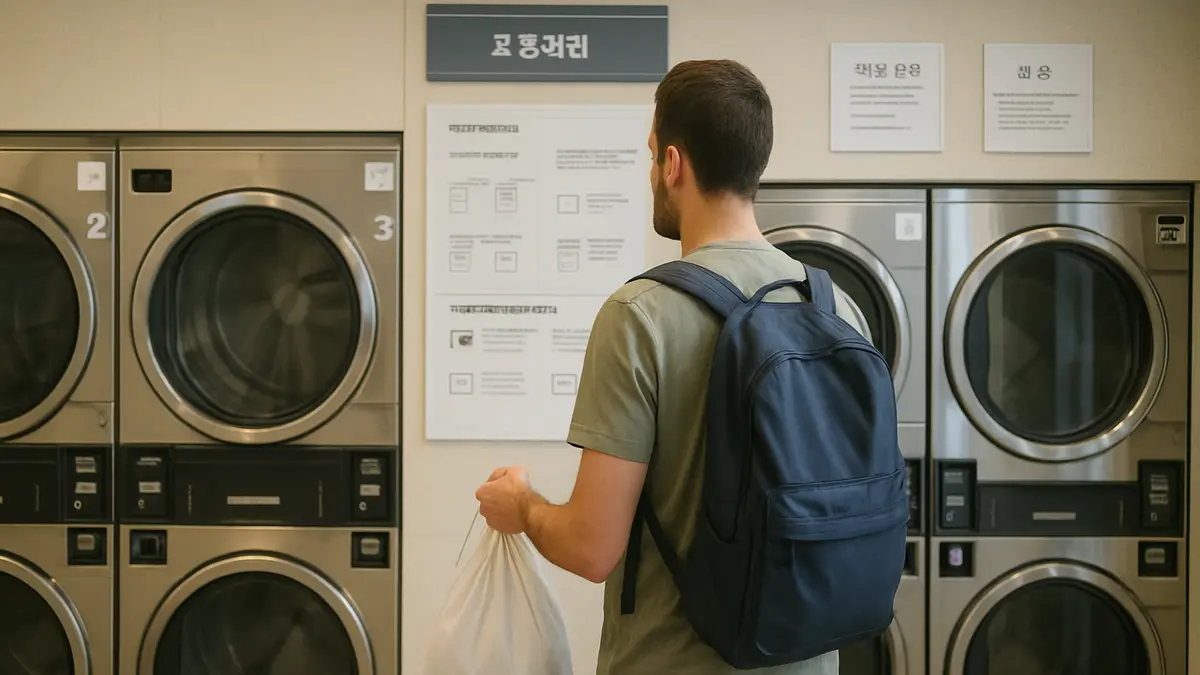
Quick answer: To learn how to use a coin laundry in Korea, search for 셀프빨래방, inspect the payment and detergent instructions before putting anything in a machine, and choose a dryer setting cautiously. Do not assume every shop takes a foreign card, includes detergent or follows the same button sequence.
How to Use a Coin Laundry in Korea: Start With the Right Search
The most useful Korean search term is 셀프빨래방 (self-service laundromat). Try it in your map app with your neighbourhood name, hotel or station. 코인세탁 is another useful term connected with coin laundry services. These searches are usually more practical than relying on the English word “laundromat”.
Look at the shop before committing to a walk. A map listing may help you identify a nearby option, but do not rely on it alone for current hours, prices or payment methods. Those details can differ between branches, even within a chain.
On arrival, pause for a minute before opening a washer. Find the payment area, machine instructions, detergent information and any customer-support number. Many Korean laundries are unmanned, so this short check is the easiest way to avoid having wet clothes in a machine you cannot start.
Use a payment-first workflow
A “coin laundry” does not guarantee that coins are the only method, or even the main method. Some locations use a central kiosk rather than payment on each machine. Others have their own electronic or mobile-payment system. WashEnjoy, for example, promotes unmanned kiosks and mobile payment, while its Wash&Pay system lists PAYCO, Apple Pay, Samsung Pay and Naver Pay at participating systems.
That does not mean your preferred payment method will work at every WashEnjoy branch, or that Apple Pay means every foreign-issued card will be accepted. Foreign-card acceptance at unattended Korean laundry terminals is not confirmed as a nationwide rule. Read the screen and signs at the individual shop before you load your washing.
| What you see | What to check | Best next step |
|---|---|---|
| Machine coin slot | Which denominations it accepts and whether it gives change | Prepare cash before starting. |
| Central kiosk | Whether you select a machine number before or after payment | Read the full sequence, then note your machine number. |
| Mobile-payment sign | The exact service named on the sign or kiosk | Use it only if your phone and payment account are ready. |
| No clear payment instructions | Support contact and any bilingual notice | Do not load clothes until you understand the method. |
Carry some Korean won as a practical backup. Officially issued notes include 1,000, 5,000, 10,000 and 50,000 won, and common coins include 100 and 500 won. A branch’s change machine and the denominations it accepts are still specific to that branch, so do not assume it will change a large note.
If a card or mobile payment fails, stop before the wash begins. Check whether the kiosk offers another method, use available cash, or choose another laundry. Repeatedly tapping a card will not solve an unsupported terminal.
Read the Korean labels that matter
You do not need to translate every button. These words cover the decisions that matter most:
- 세탁 — washing.
- 건조 — drying.
- 세제 — laundry detergent.
- 섬유유연제 — fabric softener.
- 드럼 세탁기 — front-loading washing machine.
- 일반 세탁기 or 통돌이 세탁기 — conventional or top-loading washing machine.
- 액상 or 액체 — liquid detergent; 가루 — powder detergent.
Photograph the instruction panel before paying if it is only in Korean. Translation tools can help with a sign, but machine menus and course names are not standard across every operator. The important part is identifying the washer, dryer, detergent arrangement and payment sequence, rather than trying to decode every feature.
Check detergent before you choose a washer
Do not pour detergent into a drawer simply because you see one. Some operators supply it automatically, while others may expect you to buy or add your own. Cleantopia currently states that its self-service coin-wash stores automatically dispense detergent and fabric softener at no extra charge. Treat that as a Cleantopia policy, not a rule for every Korean laundry.
Look for a clear notice about automatic dispensing, detergent or fabric softener. If the notice is unclear, buy nothing and add nothing until you have translated it or obtained help. Adding detergent to an automatically dosed machine can leave excess suds or residue on your clothes.
If you must provide detergent, use the type and compartment indicated by the machine. Keep the quantity modest and follow the product instructions. Laundry liquids and powders are not interchangeable with every dispenser layout.
Sort the load and choose a machine that fits
Separate light and dark clothes if colour transfer would spoil the load. Empty pockets, close zips, turn printed garments inside out and keep small items together in a mesh bag if you have one. These small steps matter more than chasing an unfamiliar wash programme.
Korean self-service laundries can have large machines; institutional guidance notes capacities of up to about 25 kg. That does not mean every load needs the largest washer. Choose a drum with enough room for clothes to move freely, rather than compressing everything into the smallest available option. A very full machine is harder to wash evenly and harder to dry afterwards.
Wash bulky bedding, towels or a large travel load separately from delicate everyday clothing. For wool, silk, waterproof items, delicate garments, heavily stained pieces or anything marked as heat-sensitive, follow the garment-care label. A self-service laundry is convenient, but it cannot override the care instructions sewn into your clothes.
Start the wash without losing your place
- Choose the washer and check that it is empty and suitable for your load.
- Confirm the detergent arrangement and payment method.
- Load your clothes loosely and close the door properly.
- Select the course shown by that machine or kiosk.
- Pay using the stated process, keeping your receipt if one is issued.
- Check that the cycle has actually started before leaving the shop.
Do not assume the machine number is obvious. In a kiosk-based shop, match the number on the washer or dryer to the number on the payment screen carefully. If something looks wrong after payment, use the displayed support contact promptly rather than opening the door or trying another machine.
A named chain may advertise a particular process time. Cleantopia advertises an approximately 60-minute total wash-and-dry process for its self-service offering, but that is not a promise for every branch, machine or load. Build spare time into your day, especially if you need both washing and drying.
Drying: choose the safer option, not the fastest-looking one
Dryers are commonly available in Korean laundries, which is helpful when hotel rooms have little space for air-drying. Move washed clothes to a dryer promptly once the cycle is finished. Leaving them in a washer blocks the next person and can leave your plans stalled.
First, check the garment labels. T-shirts, socks, towels and sturdy cotton items are generally simpler to manage than heat-sensitive travel gear. For delicate fibres, waterproof clothing, bras, garments with glued trims, stretch fabrics or items you cannot afford to shrink, air-drying is the safer choice unless the care label permits tumble drying.
Use a conservative dryer selection where the machine offers choices, then inspect the load before adding more drying time. Separate very heavy towels from light synthetic tops if possible. Thick items can still feel damp when lighter clothes are ready, and repeatedly heating the entire mixed load is rough on the lighter pieces.
Before leaving, check pockets and the drum. Take everything with you, including small socks that may cling to the door seal.
If the laundry has no staff
Unmanned operation is normal at some chains, so plan for a small amount of self-service problem-solving. Look for a customer-service phone number, QR code or instructions near the kiosk. WashEnjoy advertises 24-hour customer-response services for its laundry systems, but use the support details displayed at the branch you are actually using.
If the machine stops, do not force the door or move a load into another machine without knowing what happened. Photograph the display, note the machine number and payment record, then contact the listed support channel. If you cannot resolve a payment issue before a cycle begins, keep your clothes with you and use another shop later.
First-time Korean laundry checklist
- Search 셀프빨래방 or 코인세탁 near your location.
- Check payment, detergent and support details before loading clothes.
- Keep Korean won available as a backup; do not count on foreign-card acceptance.
- Match the kiosk number to the machine number.
- Use the garment-care label to decide what should not go in a dryer.
- Stay nearby long enough to confirm the cycle has started.
Frequently asked questions
Is detergent included at Korean coin laundries?
It depends on the operator and branch. Cleantopia currently advertises automatic detergent and fabric-softener dispensing at its self-service coin-wash stores, but other laundries may require separate detergent. Check the local instructions before adding anything.
Can I use a foreign credit card at a Korean laundromat?
Do not rely on it. There is no verified nationwide rule that foreign-issued cards work at unattended laundry terminals. Check the branch’s kiosk or sign and carry Korean won as a backup.
How do I find a self-service laundromat in Korea as a tourist?
Search your map app for 셀프빨래방, the Korean term for a self-service laundromat. 코인세탁 can also help you locate coin-laundry services nearby.
For most travellers, the simplest setup is the best one: a clearly labelled laundry where you understand payment and detergent before the door closes. Use that decision rule, dry only what your care labels allow, and laundry day will take far less attention away from your trip.