I have probably watched KPop Demon Hunters close to ten times by now.
I have my daughter to thank for that. But somewhere between repeat viewings of HUNTR/X performances, the Saja Boys and songs that refuse to leave your head, I started paying more attention to something else: Seoul itself.
The rooftops, old fortress walls, mountains behind the city, busy shopping streets, food and traditional architecture all sit alongside the bright, hyper-modern world of K-pop. And strangely enough, that contrast feels very much like the real Seoul.
KPop Demon Hunters is an animated fantasy, so there isn’t a HUNTR/X headquarters or a Saja Boys stage waiting to be discovered. Some of the best KPop Demon Hunters Seoul locations connect directly to scenes and visual inspiration from the film, while others help you experience the Korean culture behind its world.
So if watching the movie made you think, I want to go there, here’s where I would start.
Are KPop Demon Hunters Seoul Locations Actually Real?
Some are. Some aren’t.
That’s probably the most important thing to know before planning a KPop Demon Hunters trip around Seoul.
The movie uses recognisable Seoul landmarks and Korean architecture, but it also combines, changes and reimagines places to fit its fantasy world. You shouldn’t expect to arrive somewhere and find every scene looking exactly as it did on screen.
Instead, think of this as discovering the real Seoul behind KPop Demon Hunters.
Naksan Park, Bukchon Hanok Village, Gyeongbokgung Palace, N Seoul Tower, Myeong-dong and COEX are among the real places associated with the film and its version of Seoul.
Together, they show something the movie captures surprisingly well: Korea’s old and new identities don’t live in separate worlds.
You can spend the morning inside a centuries-old palace and later stand beneath an enormous digital K-pop screen. You can walk beside an old fortress wall in the afternoon and be surrounded by beauty stores, cafes and neon signs that evening.
That contrast is part of what makes Seoul so interesting.
Naksan Park: One of the Strongest Connections to the Movie
If I were choosing only one KPop Demon Hunters location to visit, Naksan Park would be near the top of my list.
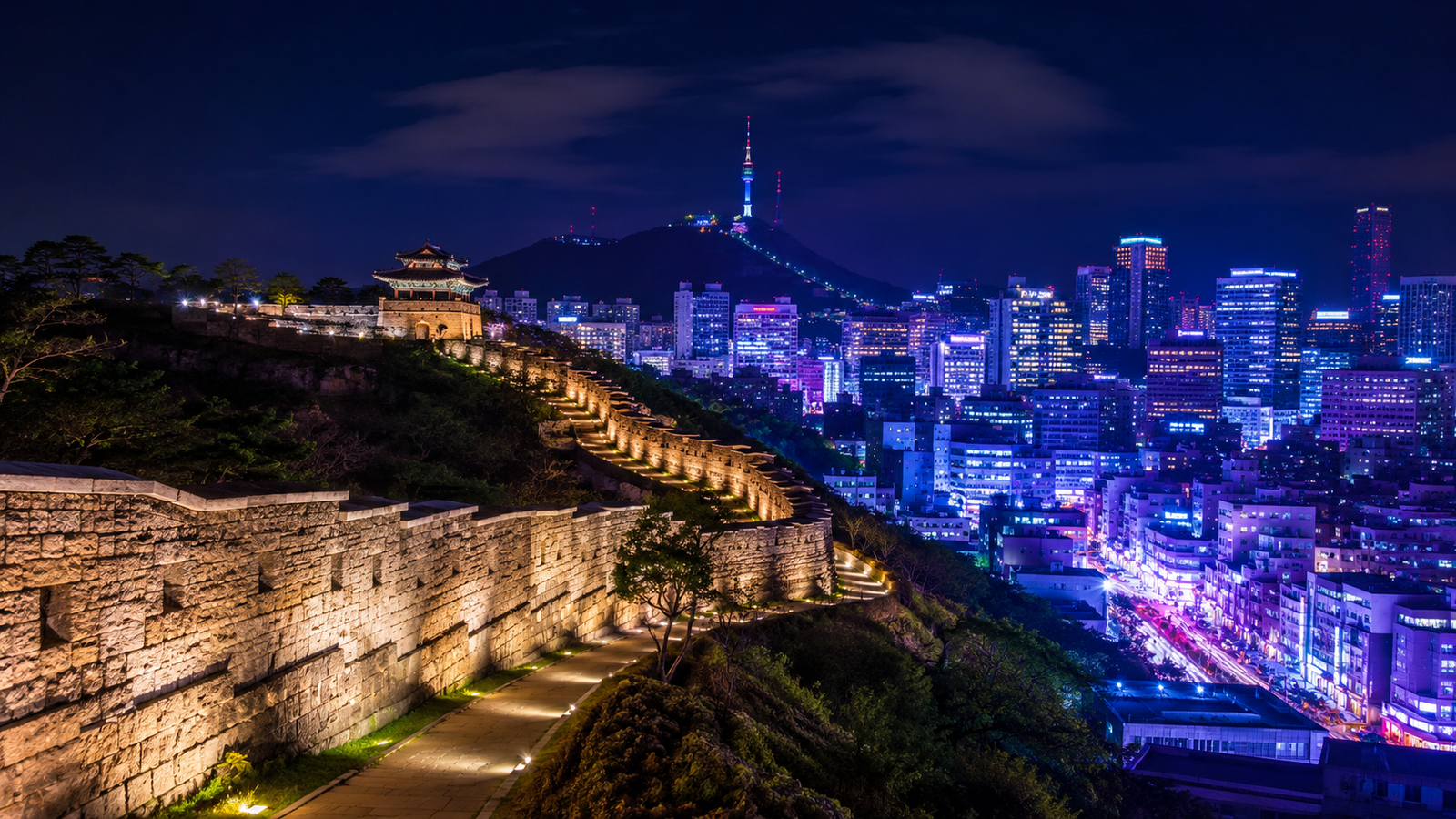
The Seoul City Wall here provides the setting for Rumi and Jinu’s conversation, and it’s one of those places where the real location already has enough atmosphere without needing anything added to it.
The old stone wall curves along the hillside while modern Seoul stretches out below.
Visit in the late afternoon and the experience changes as you walk. The neighbourhoods are still visible in daylight when you arrive, but gradually thousands of city lights begin appearing beneath you.
It’s quiet in places, dramatic without trying too hard, and feels completely different from the crowded shopping districts many visitors picture when they think of Seoul.
Among the KPop Demon Hunters Seoul locations, Naksan Park has one of the strongest connections to the movie.
Good to know:
- Area: Jongno-gu, Seoul
- Useful subway access: Hyehwa Station, Line 4
- Admission: Free
- Best time: Late afternoon into evening
- Allow: Around 1–2 hours if you want to enjoy the walk rather than simply take a photo
Wear comfortable shoes. This is a hill and a walking route, not a staged tourist attraction.
Bukchon Hanok Village: Where the Fantasy Starts to Feel Korean
Bukchon feels almost like the opposite side of Seoul.
Bukchon is one of the KPop Demon Hunters Seoul locations that best shows the traditional side of the film.
Instead of giant screens and modern entertainment districts, its narrow lanes are lined with hanok, traditional Korean houses with tiled roofs, wooden details, stone walls and courtyards.
The neighbourhood is connected to an important Rumi and Jinu moment in the movie. But even without that scene, I would still include Bukchon on this trip.
It helps explain why the world of KPop Demon Hunters feels specifically Korean.
The film doesn’t rely on K-pop alone. Traditional architecture, patterns, clothing, folklore and visual references are constantly woven into its modern fantasy.
Walking through Bukchon lets you see part of that visual language in real life.
There is one important thing fans need to remember, though.
Bukchon is not a film set. People actually live here.
Parts of the neighbourhood have visitor restrictions, so keep your voice down, don’t block gates or entrances and respect private homes. Check the latest official visitor hours before you go, as access rules can change.
Come for the movie connection, but treat the neighbourhood as someone’s home.
Gyeongbokgung Palace: Look Beyond the Photo Spot
From Bukchon, it makes sense to continue toward Gyeongbokgung Palace.
The palace connects with the historical side of the film and imagery surrounding Jinu’s past, but this is also where I’d suggest forgetting about KPop Demon Hunters for an hour and simply enjoying Korea.
Built as the main royal palace of the Joseon dynasty, Gyeongbokgung gives you a much closer look at traditional palace architecture, huge courtyards, tiled roofs and colourful dancheong decoration.
For a first-time visitor, this adds important context.
You begin to realise that many of the details appearing in Korean dramas, animation, music videos and fantasy stories aren’t just decorative “Asian-style” imagery. They come from particular parts of Korean history and culture.
Bukchon and Gyeongbokgung are close enough to visit together, which makes them an easy combination for the first half of your day.
N Seoul Tower: Yes, That Skyline Is Real
Then there’s one of the easiest Seoul landmarks to recognise: N Seoul Tower.
The tower forms part of the setting surrounding the film’s climactic performance, although the actual HUNTR/X performance venue is fictional.
So don’t arrive expecting to find the stage from the movie.
What you will find is one of Seoul’s most recognisable panoramic views.
N Seoul Tower sits on Namsan above the city and appears between buildings from countless streets below. After dark, the surrounding city becomes a huge field of lights.
If you visit both Naksan Park and N Seoul Tower during your trip, you’ll also see Seoul from two very different perspectives.
Naksan feels intimate: old walls, walking paths and neighbourhoods.
N Seoul Tower gives you the scale of the entire city.
Suddenly, the enormous Seoul depicted in the movie doesn’t seem quite so exaggerated.
Myeong-dong: Now Let’s Talk About Food
After palaces, hills and all that walking, this is the part I’d personally look forward to.
Food.
Myeong-dong is associated with the Saja Boys’ appearance in the movie, but in real life it’s also one of Seoul’s busiest shopping and street-food areas.
The atmosphere changes immediately.
Beauty stores, fashion shops, bright signs, crowds and food stalls all compete for your attention.
Try tteokbokki if you want chewy rice cakes covered in a spicy-sweet red sauce. Hotteok is a good choice when you want something warm and sweet, while gyeranppang, soft bread baked with egg, is an easy snack to eat while walking.
You’ll also find grilled skewers, dumplings and plenty of foods that somehow make you hungry even if you weren’t five minutes earlier.
You don’t need to search for one exact “KPop Demon Hunters restaurant.”
It’s more fun to experience the kind of Korean street-food culture that helps give the movie’s Seoul its personality.
And if K-beauty is also on your Korea list, Myeong-dong makes it very easy to combine the two.
What About Hongdae?
Hongdae isn’t one of the main locations I would describe as a direct KPop Demon Hunters location.
But I would still recommend it to fans who want to experience the younger, performance-driven side of Seoul.
Around Hongik University, you’ll find street performances, dance, fashion, music, cafes, photo booths and plenty of K-pop-related shopping.
This is where the difference between a movie location and a K-culture experience matters.
Go to Naksan or Bukchon because you recognise their connection to the film.
Go to Hongdae because you want to experience some of the youth culture and creative energy that makes a story about Korean pop stars feel believable in the first place.
Hongik University Station is also connected to the Airport Railroad, which makes the area particularly convenient for many international visitors.
COEX K-pop Square: Meet the Other Seoul
If Bukchon represents one side of Seoul, Gangnam shows you another.
Around COEX, enormous digital screens, shopping centres and modern architecture create the high-tech cityscape associated with contemporary Korean entertainment.
COEX K-pop Square is connected with the unveiling of HUNTR/X’s “Golden” music video in the film.
In reality, don’t expect a permanent HUNTR/X display. Digital content changes.
But standing among the giant screens in Gangnam makes it easy to understand where the movie gets some of its larger-than-life entertainment-industry aesthetic.
This is modern K-pop Seoul turned up to full volume.
Don’t Spend the Whole Trip Chasing Movie Locations
This is probably my biggest suggestion.
Leave some space between the photo spots.
If you’re near a traditional market such as Gwangjang Market, wander around before deciding what to eat. Try bindaetteok, tteokbokki or gimbap and watch what’s happening around you.
If you’re near the Han River later in your trip, grab instant ramen from a convenience store and cook it using one of the ramen machines found around popular riverside areas.
It sounds ridiculously simple.
It’s also one of those everyday Korean experiences people repeatedly see in dramas, variety shows and online videos and genuinely enjoy trying when they finally visit.
For dinner, Korean barbecue or fried chicken is an easy way to finish a long walking day.
Sometimes the part you remember most isn’t recreating a scene.
It’s sitting beside the Han River eating ramen after spending eight hours walking around Seoul.
A Few Things That Make Exploring Seoul Much Easier
Before you start saving all these places, download Naver Map or KakaoMap.
Google Maps can still be useful for general searches in Korea, but local Korean mapping apps usually provide more useful navigation and public-transport information.
OzKore Tip: Save the Korean names of places in your map app before leaving your hotel. It can make finding entrances, bus stops and smaller locations much easier.
You’ll also need a suitable payment option for Seoul’s buses and subways, such as T-money or another transit card that fits your trip.
The Seoul subway map can look intimidating the first time you see it because the network is enormous. After a few journeys, however, it becomes surprisingly manageable, and major stations have extensive English signage.
Papago is also useful to keep on your phone for translation.
You don’t need to speak fluent Korean to explore Seoul independently. A few basic phrases, a good map, a translation app and a little patience will take you a long way.
How I Would Plan a KPop Demon Hunters-Inspired Seoul Trip
Don’t try to squeeze every location into one day.
The route makes much more sense when you group places together.
For a historic Seoul day, start around Gyeongbokgung Palace and Bukchon Hanok Village. Take your time there, then head toward Naksan Park later in the afternoon and stay as the city lights begin to appear.
For a modern Seoul day, explore Myeong-dong, try some street food and continue toward N Seoul Tower.
Save COEX and Gangnam for another part of the trip rather than crossing the entire city simply to tick one location off a list.
And if you have another evening free, add Hongdae.
Not because you need another movie location.
Because it’s fun.
That’s the difference between following a checklist and actually experiencing Seoul.
Why KPop Demon Hunters Works So Well as a Korea Travel Starting Point
After watching the movie so many times, this is probably what stands out to me most.
KPop Demon Hunters doesn’t make Korea interesting simply because it has K-pop idols in it.
It works because the modern and traditional elements aren’t kept apart.
There are pop stars and demons, but there are also traditional visual motifs, food, rooftops, palaces, fortress walls and a version of Seoul that constantly moves between old and new.
That’s also one of the most interesting things about visiting Korea.
You can spend the morning inside a Joseon-era palace, the afternoon shopping for Korean skincare, watch street dancers in the evening and finish the night eating convenience-store ramen beside the Han River.
It shouldn’t necessarily fit together.
Somehow, in Seoul, it does.
Frequently Asked Questions
Are the KPop Demon Hunters locations in Seoul real?
Several real Seoul landmarks are connected to scenes or visual inspiration in the movie, including Naksan Park, Bukchon Hanok Village, Gyeongbokgung Palace, N Seoul Tower, Myeong-dong and COEX. However, KPop Demon Hunters is an animated fantasy, so some environments and venues are fictional or creatively reimagined.
Can I visit the final HUNTR/X concert venue?
Not exactly as it appears in the movie. The performance setting is fictional, although N Seoul Tower is a real Seoul landmark associated with the sequence and can be visited.
What is the best KPop Demon Hunters location to visit?
If you want a strong movie connection combined with a beautiful Seoul experience, Naksan Park is an excellent choice. Bukchon is another standout for fans interested in the movie’s traditional Korean visual influences.
Can I visit all these places in one day?
You could reach several, but I wouldn’t recommend trying to see everything. Gyeongbokgung, Bukchon and Naksan work well together. Myeong-dong and N Seoul Tower can form another route, while COEX is better combined with a Gangnam day.
Do I need to speak Korean?
No. Seoul’s major subway stations and tourist attractions generally have English signage. Naver Map or KakaoMap and a translation app such as Papago make independent travel considerably easier.
Final Thoughts
If KPop Demon Hunters is what first made you curious about Seoul, use it as the beginning of the trip rather than the entire reason for it.
Find the wall where the city suddenly looks familiar. Walk through the hanok neighbourhoods. Look up at N Seoul Tower. Eat something you’ve only ever seen on a screen.
But then wander somewhere that wasn’t in the movie.
That’s when Seoul becomes much more interesting.
The film gives you the fantasy.
The real city gives you everything around it.