Table of Contents
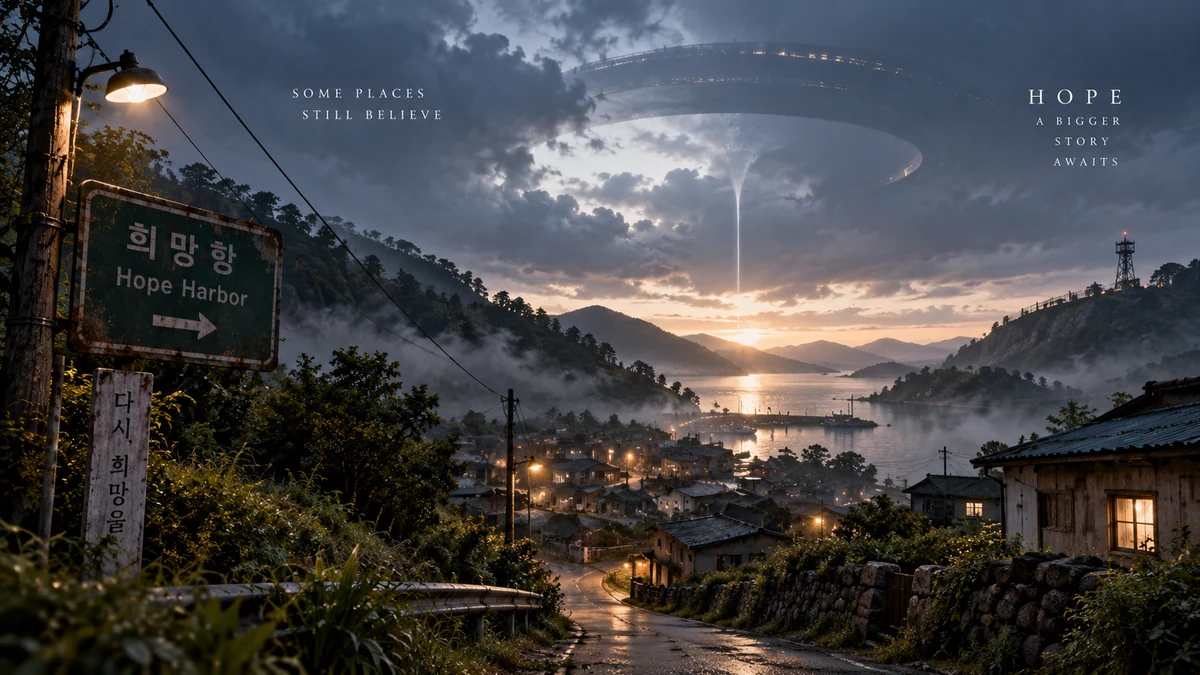
A remote Korean village.
A mysterious attack.
A community suddenly cut off from the outside world.
And something in the mountains that nobody quite understands.
That already sounds like enough for a Korean thriller.
Then HOPE gets much bigger.
Directed by Na Hong-jin, the filmmaker behind The Wailing, The Chaser and The Yellow Sea, HOPE is one of the most ambitious Korean genre films of 2026.
It combines science fiction, thriller and action with a remarkably international cast including Hwang Jung-min, Zo In-sung, Hoyeon, Michael Fassbender, Alicia Vikander and Taylor Russell.
After premiering in competition at Cannes and opening in Korea during the summer, the film is now reaching more international audiences.
So what exactly is HOPE — and why has this strange Korean sci-fi movie attracted so much attention?
Here is the spoiler-light guide.
What Is the HOPE Korean Movie About?
HOPE takes place in a remote Korean community known as Hope Harbor.
Something strange has happened.
A series of violent incidents creates fear in the village, and local residents begin trying to understand what kind of threat they are dealing with.
Police chief Bum-seok and officer Sung-ae become caught in the emergency, while Sung-ki and other villagers head into the mountains looking for answers.
They quickly discover that the situation is far bigger than a normal animal attack.
Communications collapse.
The village becomes increasingly isolated.
And what initially appears to be a local mystery begins expanding into something much more dangerous.
That is about as far as you should go before watching.
HOPE works partly because it keeps changing your understanding of what kind of movie you are watching.
HOPE Is Na Hong-jin’s First Feature in 10 Years
For Korean movie fans, the director’s name may be the biggest reason to pay attention.
Na Hong-jin does not make films very often.
His feature-film career includes The Chaser, The Yellow Sea and The Wailing.
Each developed a reputation for taking familiar genre ingredients and making them considerably stranger, darker and less predictable.
HOPE is his first feature since The Wailing in 2016.
That ten-year gap created enormous expectations.
But rather than returning with another relatively contained horror story, Na went in the opposite direction.
HOPE is huge.
Its official Korean Film Council listing classifies it as science fiction, thriller and action, with a running time of 156 minutes.
This is Na Hong-jin operating on blockbuster scale.
Why The Wailing Fans Will Immediately Be Curious
If you watched The Wailing, the basic setup of HOPE may feel strangely familiar.
A rural Korean community encounters something it does not understand.
Rumors spread.
People make assumptions.
Fear changes how they behave.
And the audience is never entirely sure who understands the situation correctly.
But HOPE is not simply The Wailing with aliens.
The scale and genre are different.
The important connection is Na Hong-jin’s fascination with uncertainty.
His characters rarely receive a neat instruction manual explaining the threat.
They see fragments.
They interpret them.
Then they act.
Sometimes disastrously.
The Real Theme May Be Misunderstanding
The official Korean Film Council description gives away something important about the movie without spoiling its plot.
It describes a tragedy that begins with ignorance and misunderstanding before escalating into a much larger conflict between opposing perspectives.
That idea is more interesting than simply asking, “What is the monster?”
HOPE is fascinated by what happens when two sides encounter each other without truly understanding what they are seeing.
Humans naturally try to explain unfamiliar things using familiar categories.
Animal.
Enemy.
Danger.
Monster.
But what if the category itself is wrong?
That question gives HOPE more to think about than its action-heavy marketing might suggest.
Why Is the Movie Set in a Remote Korean Village?
The location is important.
Instead of setting a giant science-fiction story in futuristic Seoul, HOPE begins in a relatively isolated community.
That changes everything.
People know one another.
Information travels through personal relationships.
Local police do not behave like anonymous authorities arriving from somewhere else; they belong to the community.
And once communication with the outside world becomes difficult, the village has to respond largely with the people and knowledge already available.
The contrast is wonderful.
A small Korean community is forced to deal with a problem of potentially enormous scale.
The DMZ Setting Adds Another Layer
The story is also associated with an area near Korea’s Demilitarized Zone.
For international viewers, the DMZ may immediately suggest North and South Korea.
But visually and geographically, the border region can also represent isolation, military tension, mountains, restricted space and uncertainty about what exists beyond a boundary.
That makes it unusually effective territory for science fiction.
A mysterious presence entering this landscape does not arrive in an emotionally neutral place.
It arrives somewhere already shaped by division and suspicion.
You do not need to understand Korean politics to enjoy HOPE.
But knowing that background makes the setting feel less random.
Who Is in the HOPE Cast?
The cast is one of the most unusual combinations assembled for a Korean film.
Hwang Jung-min
Hwang Jung-min plays Bum-seok, the local police chief at the center of the escalating crisis.
International Korean-cinema fans may recognize him from films including Veteran, The Spy Gone North and 12.12: The Day.
He gives HOPE something essential: a very human center inside an increasingly inhuman situation.
Zo In-sung
Zo In-sung plays Sung-ki, one of the villagers who heads into the mountains as the threat develops.
K-drama audiences may know him from It’s Okay, That’s Love, while film audiences have seen him in projects including Escape from Mogadishu and Smugglers.
Hoyeon
Hoyeon plays Sung-ae, a police officer confronting the crisis alongside Bum-seok.
For much of the international audience, she remains instantly recognizable as Kang Sae-byeok from Squid Game.
HOPE gives viewers a very different version of her screen presence.
Then There Is the International Cast
This is where HOPE becomes particularly unusual.
Michael Fassbender.
Alicia Vikander.
Taylor Russell.
Cameron Britton.
These are not simply names attached to an English-language remake or international distribution deal.
They are part of Na Hong-jin’s actual science-fiction world.
That gives HOPE a genuinely international identity while keeping the center of the story firmly rooted in Korea.
It is a Korean film expanding outward rather than a Hollywood production borrowing Korean aesthetics.
HOPE Went to Cannes Before Its Korean Release
HOPE had its world premiere at the 2026 Cannes Film Festival, where it competed for the Palme d’Or.
That was a major moment for Korean cinema and for Na Hong-jin personally.
The film later appeared on the festival circuit at events including the New York Asian Film Festival and Toronto International Film Festival.
That festival journey helped position HOPE as something unusual:
an enormous Korean genre movie that could operate both as a festival title and a commercial spectacle.
How Big Is HOPE in Korea?
Very big.
HOPE opened in South Korea on July 15, 2026.
According to Korean Film Council data, the film had attracted roughly 4.55 million admissions in Korea by September 9.
For a long, unusual science-fiction thriller from a director known for challenging audiences, that is significant.
It also shows that HOPE is not merely an international festival curiosity.
Korean audiences have turned it into a major theatrical event.
Why Is HOPE Trending Again Now?
Because its international release is expanding.
After the Korean summer release and festival screenings, HOPE opened theatrically in North America in September.
Other territories are following.
That creates a second search wave.
People who heard about the movie during Cannes are finally able to watch it.
Hoyeon fans are discovering it.
The Wailing fans are searching for Na Hong-jin’s return.
And viewers encountering a Korean monster movie with Michael Fassbender and Alicia Vikander understandably have questions.
Is HOPE a Horror Movie?
Not exactly.
If you go in expecting another supernatural horror film like The Wailing, you may be surprised.
The Korean Film Council officially categorizes HOPE as science fiction, thriller and action.
There are frightening and violent elements, but its ambitions are broader than conventional horror.
It moves between suspense, creature feature, action spectacle, dark comedy and science fiction.
Sometimes it seems determined to become several movies at once.
Whether that sounds exciting or exhausting may tell you a lot about whether HOPE is for you.
Is HOPE Very Violent?
Yes.
This is not a gentle science-fiction adventure.
The film contains intense violence and bloody imagery, and international classifications reflect that.
Viewers sensitive to gore should check their local rating before booking a ticket.
Na Hong-jin has never been particularly interested in making danger look tidy.
HOPE continues that tradition on a much larger canvas.
How Long Is HOPE?
The Korean Film Council lists the movie at 156 minutes.
Some international cinema listings round or list the running time slightly differently, but the practical answer is simple:
HOPE is roughly two hours and forty minutes long.
Do not schedule dinner for two hours after the screening begins.
Is HOPE Worth Watching in a Cinema?
If you have the option, this is one Korean film where the cinema experience genuinely matters.
HOPE was designed as a large-scale theatrical spectacle.
The landscape, sound design, action and creature sequences benefit from a large screen.
Its North American release has even included premium large-format presentations such as Dolby Cinema, 4DX and ScreenX.
That does not automatically make the film better.
But it tells you what kind of experience the filmmakers and distributors believe they made.
This is not a quiet movie intended to sit politely in the background on a laptop.
What Should You Know Before Watching HOPE?
Three things.
1. Do not expect The Wailing 2
The director is the same. The feeling of uncertainty sometimes feels familiar.
The scale and genre are not.
2. Avoid detailed plot summaries
The movie’s changing perspective is part of the experience.
The less you know about exactly what is waiting in the mountains, the better.
3. Expect something strange
HOPE has divided some critics precisely because it refuses to stay inside one comfortable genre.
That unpredictability is part of the attraction.
Why HOPE Matters for Korean Cinema
For years, international audiences have associated Korean cinema with exceptionally strong thrillers, horror films and social dramas.
But HOPE points toward another possibility.
A Korean filmmaker can create a globally distributed science-fiction spectacle without removing the Korean landscape, Korean characters or Korean storytelling sensibility from its center.
That is significant.
The film reportedly sold widely across international territories following Cannes, while major international distributors backed its theatrical rollout.
HOPE is therefore interesting even beyond whether you personally love the movie.
It is another test of how large Korean genre cinema can become globally.
If You Like HOPE, What Korean Movies Should You Watch Next?
Start with Na Hong-jin.
The Wailing is the obvious choice if you want another rural community facing something terrifying and difficult to understand.
The Chaser shows the director working with a much more grounded crime-thriller structure.
The Yellow Sea is darker, brutal and relentlessly tense.
Then watch Bong Joon-ho’s The Host.
It is not a Na Hong-jin film, but its combination of Korean family dynamics, social commentary and monster-movie spectacle makes it a fascinating companion to HOPE.
Together, these films show why Korean genre cinema became so influential internationally in the first place.
FAQ
What is the Korean movie HOPE about?
HOPE follows residents of a remote Korean village confronting a mysterious and increasingly dangerous threat after a series of violent incidents. The film develops from a local mystery into a large-scale science-fiction conflict.
Who directed HOPE?
HOPE was directed by Na Hong-jin, the South Korean filmmaker behind The Chaser, The Yellow Sea and The Wailing.
Who stars in HOPE?
The cast includes Hwang Jung-min, Zo In-sung, Hoyeon, Michael Fassbender, Alicia Vikander, Taylor Russell and Cameron Britton.
Is HOPE connected to The Wailing?
No. HOPE is a separate story. However, both films were directed by Na Hong-jin and share his interest in fear, uncertainty, misunderstanding and communities confronting forces they do not fully understand.
Is HOPE horror or science fiction?
The Korean Film Council classifies HOPE as science fiction, thriller and action. It contains horror and creature-feature elements but is broader than a conventional horror movie.
How long is HOPE?
The official Korean Film Council running time is 156 minutes, making it a little over two and a half hours long.
When was HOPE released in Korea?
HOPE opened theatrically in South Korea on July 15, 2026 after premiering at the Cannes Film Festival earlier in the year.
Final Thoughts
HOPE could have been much easier.
Na Hong-jin could have returned after ten years with another tightly controlled Korean horror thriller.
Instead, he made something enormous, violent, strange and internationally ambitious.
A remote Korean village collides with science fiction.
Hwang Jung-min and Hoyeon share the screen with Michael Fassbender and Alicia Vikander.
A local emergency becomes something far larger than anyone understands.
And underneath all the spectacle sits a very Na Hong-jin question:
What happens when we become certain about something we never understood in the first place?
That makes HOPE more than another monster movie.
Whether you ultimately love its ambition or think it goes completely off the rails, it is difficult to accuse it of playing safe.
For Korean cinema in 2026, that alone makes HOPE worth watching.