Table of Contents
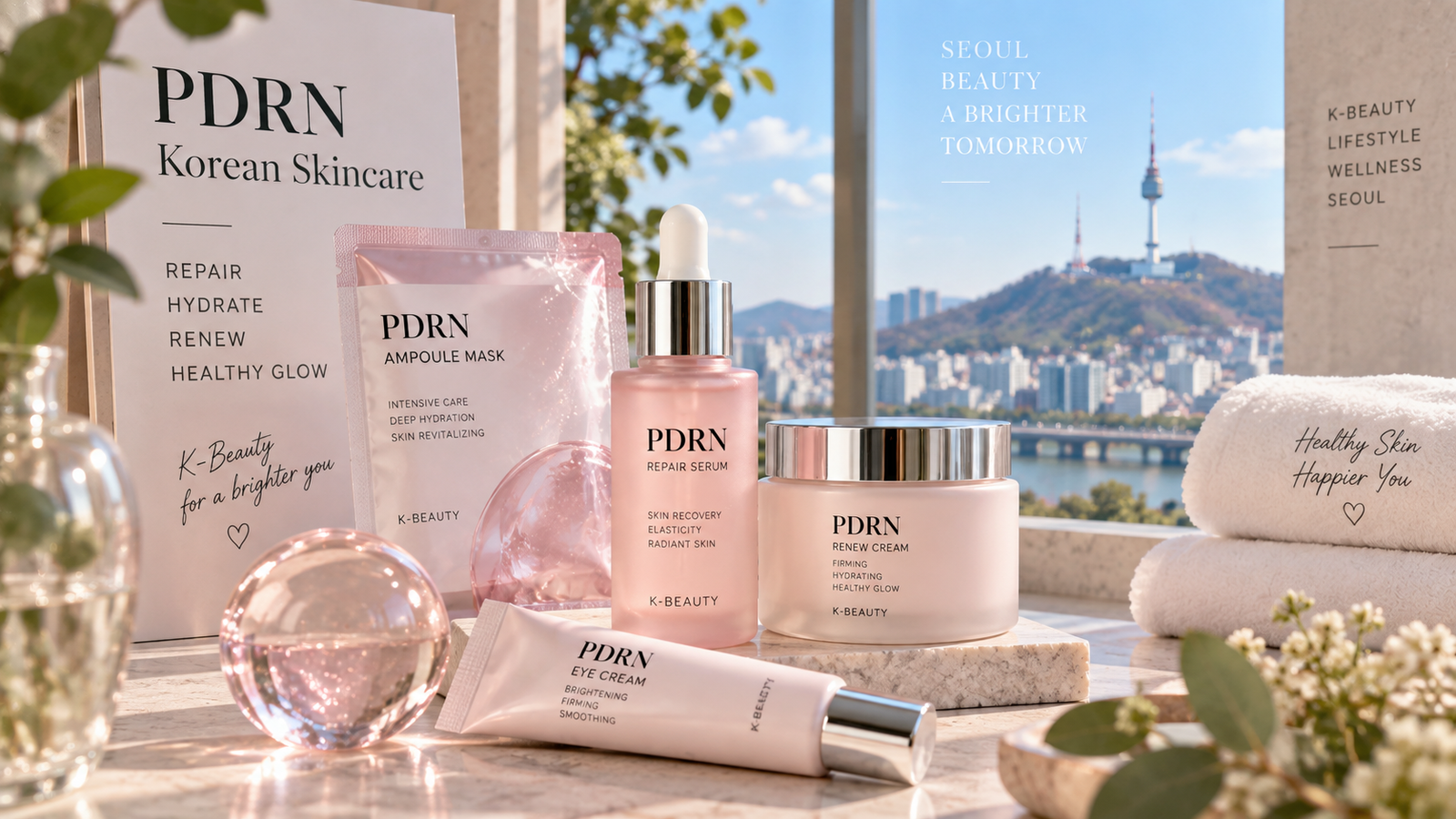
If you follow Korean beauty, you may have noticed three letters appearing everywhere: PDRN.
Serums. Creams. Masks. Ampoules.
And then there is the phrase guaranteed to make almost anyone stop scrolling:
salmon DNA skincare.
It sounds futuristic, slightly strange and very K-beauty.
But what exactly is PDRN? Why did it become such a big Korean skincare trend? And does putting PDRN in a serum mean you are getting the same benefits associated with professional Korean skin treatments?
Not exactly.
The interesting story is somewhere between genuine dermatology research, Korean beauty innovation and very clever skincare marketing.
What Is PDRN?
PDRN stands for polydeoxyribonucleotide.
It is made from purified fragments of DNA and has been studied in medical and dermatological settings for its potential role in tissue repair and skin recovery.
Many forms of PDRN used in the beauty and medical industries have traditionally been derived from salmonid sources, which is why you frequently see the much more memorable phrase “salmon DNA.”
That description can sound more dramatic than the final cosmetic ingredient actually is.
You are not opening a serum and finding visible fish DNA floating inside.
The material is highly processed and purified before being used in appropriate formulations.
Why Is PDRN So Closely Associated With Korea?
PDRN did not suddenly appear because of TikTok.
Its popularity in Korea is closely connected to the country’s wider interest in regenerative aesthetic treatments and so-called skin boosters.
Korean beauty consumers are already familiar with an approach that focuses less on dramatically changing the face and more on improving hydration, texture and overall skin condition.
That made PDRN an unusually good fit.
As professional treatments containing polynucleotides and related ingredients became more visible, cosmetic brands began bringing the terminology into everyday skincare.
Eventually, PDRN moved from clinics into beauty-store conversations.
And once it reached social media, the phrase “salmon DNA” did the rest.
Why Is PDRN Korean Skincare Trending Now?
K-beauty trends often move in cycles.
One year everyone is talking about snail mucin. Then centella. Then peptides. Then barrier repair.
PDRN has several advantages as a trend ingredient.
First, it sounds scientific.
Second, it connects to Korean aesthetic medicine.
Third, it fits perfectly with the current beauty obsession with “skin longevity,” recovery and healthy-looking skin rather than simply aggressive anti-aging.
And finally, it has a story people remember.
“Hydrating serum” is easy to forget.
“Korean salmon DNA serum” is not.
Is PDRN Still Popular in Korea?
Yes, although the market is already evolving beyond the first wave of hype.
During 2026, PDRN continued appearing across Korean beauty products and international K-beauty coverage.
Major Korean brands have released PDRN serums, creams and masks, while Korean beauty retailers continue to carry products built around the ingredient.
Recent beauty trend data has also shown continued search interest in PDRN rather than the ingredient disappearing after one viral season.
That does not mean every Korean shopper is suddenly using PDRN.
Korean skincare is far too diverse for one ingredient to define the entire market.
But PDRN has clearly moved beyond a tiny niche.
What Does PDRN Claim to Do for Skin?
Cosmetic products containing PDRN are commonly marketed around ideas such as:
- Hydration
- Skin recovery
- Improved elasticity
- Smoother-looking texture
- Barrier support
- A healthier or more radiant appearance
This is where it becomes important to separate an ingredient with interesting research from a cosmetic product making broad promises.
The presence of PDRN on an ingredient list does not automatically prove that every finished cream or serum will create a particular result.
Formula, concentration, delivery method and the other ingredients surrounding it all matter.
What Does the Research Actually Say?
PDRN is not an ingredient invented entirely by skincare marketing.
There is real scientific interest behind it.
Recent dermatology reviews have examined PDRN and related polynucleotide treatments for potential applications involving skin repair, rejuvenation and regenerative medicine.
However, there is an important catch.
A significant amount of the stronger clinical discussion involves injectable treatments, medical applications or professionally delivered therapies.
That evidence cannot automatically be transferred to a bottle of topical serum.
This distinction is especially important because social media often puts clinic treatments and cosmetic skincare into the same PDRN conversation.
They are not the same thing.
PDRN Injection vs PDRN Skincare: What Is the Difference?
This is probably the most important section of the entire guide.
A professional injectable treatment delivers material into the skin using a medical procedure.
A cosmetic serum or cream sits on the skin surface and must work within the limitations of a topical formulation.
Those are very different delivery methods.
So when you see dramatic before-and-after content associated with injectable Korean treatments, do not assume a PDRN cream will reproduce the same result.
A topical product may still be useful as part of a well-formulated skincare routine.
It simply should be judged as skincare, not as a home version of a medical procedure.
And What About PN?
You may also see another abbreviation: PN, or polynucleotide.
PDRN and PN are related DNA-derived materials, but they are not necessarily identical.
Recent scientific reviews describe differences in their molecular size and potential biological behavior.
In everyday beauty marketing, however, the terminology can become blurred.
That is another reason to read beyond the front of the packaging.
If you are buying a cosmetic product, the actual ingredient list and formula matter more than whichever scientific acronym is printed in the largest font.
Is All PDRN Made From Salmon?
No.
This part of the trend is changing quickly.
Traditional PDRN is strongly associated with salmon-derived DNA, but beauty companies are now experimenting with different ingredient stories and alternative sources.
You may encounter products marketed around plant-derived or differently sourced DNA-related ingredients.
That means shoppers should not automatically assume every product labeled PDRN has exactly the same origin or composition.
If ingredient sourcing matters to you, check the individual product information rather than relying on the category name alone.
Why Are There So Many PDRN Serums?
Serums are almost the perfect format for a trending K-beauty active.
They make the ingredient feel targeted.
They slot easily into an existing routine.
And consumers already understand the idea that a serum contains the “special” part of their skincare.
That is why PDRN often appears alongside familiar ingredients such as:
- Hyaluronic acid
- Niacinamide
- Peptides
- Centella asiatica
- Panthenol
- Adenosine
- Ceramides
In many cases, those supporting ingredients may contribute significantly to how hydrating or soothing the finished product feels.
So if your PDRN serum makes your skin feel beautifully hydrated, PDRN may not be the only reason.
How Should You Choose a PDRN Product?
Do not choose one simply because the number printed next to PDRN looks impressive.
Instead, start with what your skin actually needs.
If your skin feels dry
Look for a formula combining PDRN with proven moisturizing ingredients such as glycerin, hyaluronic acid and barrier-supporting ingredients.
If your skin feels sensitive
A simple formula may be more useful than a product packed with every trending active at once.
If you already use strong actives
Think about whether the new product complements your routine rather than simply adding another layer.
If you are buying because of anti-aging claims
Keep your expectations realistic.
No trendy cosmetic ingredient replaces the fundamentals of skincare, especially daily sun protection.
Where Does PDRN Go in a Skincare Routine?
Always follow the directions for the specific product, but a PDRN serum will usually fit into the treatment stage of a routine.
A simple routine might look like:
- Cleanser
- Toner or essence if you use one
- PDRN serum
- Moisturizer
- Sunscreen during the day
You do not need to rebuild your entire routine around PDRN.
That is one of the easiest mistakes to make when a new K-beauty ingredient becomes popular.
Add one product. See how your skin responds. Then decide whether it deserves a permanent place.
Can You Use PDRN With Retinol or Vitamin C?
There is no universal rule that PDRN cosmetics must be separated from common skincare ingredients such as vitamin C, retinoids or niacinamide.
But the complete product formula matters.
If you are already using several strong actives, introducing multiple new products at once makes it difficult to know what caused irritation if something goes wrong.
A more practical approach is to introduce a new PDRN product gradually and keep the rest of your routine familiar.
Who Might Find PDRN Skincare Interesting?
PDRN is likely to appeal most to people who enjoy Korean skincare innovation and want products focused on hydration, skin comfort and healthy-looking texture.
It may also interest travelers who encountered PDRN through Korean beauty clinics and then noticed the same term appearing in Olive Young or Korean cosmetics stores.
But you do not need PDRN simply because it is trending.
If your current routine already works well, there is no urgent reason to replace it.
K-beauty is at its best when it gives you more choices, not when it convinces you that your bathroom needs another twelve bottles.
Why PDRN Is Bigger Than One Ingredient
The most interesting thing about PDRN may not actually be PDRN itself.
It shows how Korean beauty trends now move.
An ingredient gains visibility through professional treatments.
Beauty brands translate the idea into products.
Creators make it understandable — or occasionally much more dramatic.
Global retailers notice.
Then a technical term from Korean beauty culture becomes something shoppers around the world recognize.
We have seen similar cycles with snail mucin, centella and fermented skincare.
PDRN is the latest example of Korea functioning not only as a cosmetics manufacturer, but as a global beauty trend laboratory.
PDRN and the Korean Glowcation Trend
PDRN also fits neatly into another change happening in Korean beauty: people increasingly want to experience K-beauty in Korea itself.
Visitors may shop for Korean skincare, book a Korean personal color analysis, try Korean scalp care, explore beauty stores in Seongsu and learn about treatments they first saw online.
This is part of what we call a Korean glowcation — a Korea trip where beauty and wellness become part of the itinerary rather than simply something purchased before flying home.
PDRN sits directly between those two worlds.
It is both a skincare trend on store shelves and a term many visitors first encounter through Korea’s professional beauty industry.
Should You Buy PDRN Skincare in Korea?
If you are already visiting Korea, PDRN products can be fun to explore because the selection is generally much wider than in many overseas markets.
Large beauty retailers can also make it easier to compare textures and formulations in person.
But do not assume the most viral product is automatically the best one for you.
Compare the full formula.
Look at what problem the product is actually designed to solve.
And remember that “Korean” does not automatically mean gentle, effective or suitable for every skin type.
Good skincare still requires choosing according to your own skin.
Is PDRN the New Snail Mucin?
From a trend perspective, you can see why people make the comparison.
Both ingredients have unusual origin stories.
Both became strongly associated with Korean beauty.
Both create immediate curiosity from people who have never heard of them.
But the two trends are not identical.
Snail mucin grew primarily as a cosmetic skincare phenomenon.
PDRN has a much stronger connection to medical and aesthetic-treatment language.
That makes PDRN more complicated — and arguably more interesting.
FAQ
What does PDRN mean in Korean skincare?
PDRN stands for polydeoxyribonucleotide, a DNA-derived material studied in medical and dermatological applications. It is now also used or referenced in a growing range of Korean cosmetic products.
Is PDRN really salmon DNA?
Many traditional forms of PDRN are derived from purified DNA material from salmonid sources, which led to the popular “salmon DNA” nickname. However, product sourcing can vary, so check the specific formulation.
Does PDRN skincare work?
PDRN has legitimate scientific research behind it, but much of the stronger clinical evidence relates to medical or professionally delivered treatments rather than ordinary topical cosmetics. The performance of a serum or cream depends on the complete formulation.
Is PDRN skincare the same as a PDRN injection?
No. A topical cosmetic and an injectable professional treatment use very different delivery methods and should not be expected to produce identical results.
Can I use PDRN skincare every day?
Many cosmetic PDRN products are designed for regular use, but follow the directions of the specific product and introduce new skincare gradually if your skin is sensitive.
Is PDRN popular in Korea?
Yes. PDRN continues to appear across Korean skincare launches and beauty retail in 2026, although it is one of many ingredients competing for attention in Korea’s fast-moving skincare market.
Final Thoughts
PDRN has almost everything required for a perfect K-beauty trend.
Science.
A connection to Seoul’s beauty industry.
Unusual origins.
Beautifully packaged serums.
And a nickname — “salmon DNA” — that practically writes its own TikTok headline.
But the smartest way to approach PDRN is less dramatic.
There is genuine research behind the ingredient, but a cosmetic serum is not the same thing as a professional treatment.
Look past the acronym. Look at the entire formula. Decide what your skin actually needs.
Then, if PDRN fits that need, enjoy one of the most interesting ingredients in the current Korean beauty conversation.